

What’s the best online course you’ve ever taken?
How design thinking transformed the way I approach business strategy, entrepreneurship, marketing, and problem-solving.
What is the best online course I have ever taken?
My answer is Design-Led Strategy: Design Thinking for Business Strategy and Entrepreneurship, offered by the University of Sydney through Coursera.
As a marketing professional, business consultant, and entrepreneur, I have always been interested in understanding what makes businesses succeed—not just how they promote their products or services, but how they identify the right problems, understand their customers, develop meaningful solutions, and make strategic decisions.
This course brought together several areas that I find particularly valuable: design thinking, business strategy, customer research, innovation, and entrepreneurship.
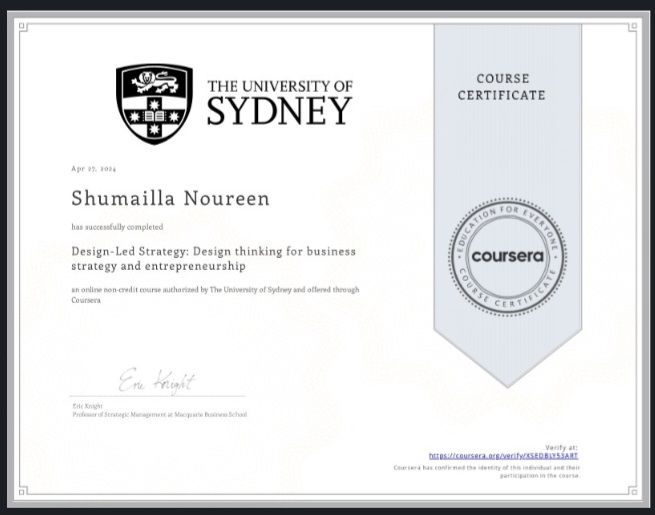
I completed the course on 29 April 2024, earning a course certificate issued through Coursera for the University of Sydney’s online learning offering.

For me, its subject matter represents an important principle of professional growth: learning becomes more valuable when it changes how we think, make decisions, and solve real-world problems.
In this article, I’ll explain what the course covers, why I value its approach, how design-led strategy can be applied to digital marketing and business consulting, and who might benefit from taking it.
What Is the Design-Led Strategy Online Course?
The Design-Led Strategy: Design Thinking for Business Strategy and Entrepreneurship course introduces learners to the relationship between design thinking, corporate strategy, and entrepreneurial innovation.
According to the official course page on Coursera, the course explores how organisations can use design-led approaches to develop products and services informed by customer insights, test ideas, and incorporate innovation into business strategy.
The course description also highlights case studies involving UBank and Swiss Re, illustrating how organisations can apply design strategy in practice.
Here are the key details:
- Course title: Design-Led Strategy: Design Thinking for Business Strategy and Entrepreneurship
- Institution: The University of Sydney, Australia
- Learning platform: Coursera
- My completion date: 29 April 2024
- Credential: Online course certificate
- Subject areas: Design thinking, business strategy, customer research, innovation, product development, and entrepreneurship
My certificate identifies the course as an online, non-credit course authorised by the University of Sydney and offered through Coursera.
This distinction matters: it is a professional learning credential, not an academic degree or university credit.
The course’s current page provides the latest syllabus, enrolment information, and learning arrangements. Prospective learners should check those details directly because course offerings and delivery information can change.
Explore the course: Design-Led Strategy on Coursera.
Why Did I Choose This Course?
My professional background spans marketing, business management, consulting, and entrepreneurship. Across these areas, I have repeatedly encountered a common challenge: businesses sometimes invest considerable effort in solving a problem before establishing whether they have understood it correctly.
For example, a business experiencing low sales might immediately increase its advertising budget. A website with poor conversion rates might be redesigned without investigating what visitors find confusing. An entrepreneur might launch a new service based on personal assumptions rather than evidence of customer demand.
But what if the visible problem is only a symptom of something deeper?
What if the real issue is unclear positioning, a lack of customer trust, a poorly defined offer, or a mismatch between what a business provides and what its customers actually need?
These questions explain why design-led strategy interests me.
It encourages us to look beyond the obvious, investigate the underlying problem, and use customer understanding to inform strategic decisions.
I value learning that helps me move from simply executing tasks to thinking more critically about why those tasks matter and whether they are likely to produce meaningful results.
What Is Design Thinking, and How Does It Support Business Strategy?
Design thinking is a human-centred approach to problem-solving that combines an understanding of people’s needs with the exploration, development, and testing of possible solutions.
It is not limited to graphic design, website layouts, or product aesthetics. It can also help organisations rethink services, improve customer experiences, identify opportunities, and challenge established business assumptions.
Stanford University’s design thinking process guide describes five commonly used stages:
- Empathise: Understand the experiences, needs, and challenges of the people you are designing for.
- Define: Use what you have learned to articulate the problem clearly.
- Ideate: Explore different ways to address the problem.
- Prototype: Develop a preliminary version of a potential solution.
- Test: Gather feedback, learn what works, and refine the solution.
These stages are a useful framework, although design thinking is often iterative rather than a rigid, one-directional process. What we learn during testing may require us to redefine the problem or explore a different solution.
For business leaders, entrepreneurs, and marketing professionals, this approach offers an important lesson: understanding the problem is as important as developing the solution.
A business strategy should not be driven solely by assumptions, trends, or what competitors happen to be doing. It should also consider customer needs, available evidence, organisational capabilities, and commercial viability.
For further reading, Stanford University’s Human-Centered Design Project Guide provides practical guidance for investigating problems, discovering opportunities, and developing potential solutions.
Five Reasons I Value Design-Led Strategy
1. It encourages me to question assumptions
In business, assumptions can easily become accepted as facts.
A business owner may believe that customers are primarily concerned about price. However, customer research might reveal that they are more concerned about reliability, convenience, quality, or confidence in the service provider.
Similarly, a company might assume that its marketing campaign is underperforming because it needs a larger budget, when the actual problem is that the offer is unclear or the campaign is reaching the wrong audience.
Questioning assumptions encourages us to investigate before making significant decisions.
For me, this is a valuable mindset in marketing consultancy, where recommendations should be based on a thoughtful assessment of the client’s circumstances rather than a standard list of tactics.
2. It puts customers and people at the centre
Businesses serve people, yet organisations sometimes make decisions primarily around internal processes, management preferences, or short-term targets.
A human-centred approach encourages us to understand customers’ needs, expectations, frustrations, and decision-making processes.
For example, instead of asking, “How can we sell more of this service?”, a business might first ask:
- What problem is the customer trying to solve?
- What alternatives are they considering?
- What prevents them from making a decision?
- What information would help them feel confident?
- What would make the service genuinely useful to them?
These questions can inform product development, service design, customer communication, and marketing strategy.
They also support a more consultative approach to business development: understand the customer’s situation first, then recommend a solution that genuinely fits.
3. It connects creativity with strategic thinking
Creativity and strategy are sometimes treated as separate disciplines. Creativity is associated with generating ideas, while strategy focuses on planning, analysis, and achieving objectives.
Design-led strategy provides a way to bring them together.
Creative thinking helps generate alternative solutions. Strategic thinking helps evaluate which solutions are relevant, feasible, and commercially sensible.
For example, a small business might explore several ways to improve its customer experience: simplifying its booking process, introducing clearer service packages, improving onboarding, or offering more useful information before purchase.
The objective is not to choose the most exciting idea automatically. It is to identify the solution that best addresses the problem while fitting the business’s resources and goals.
4. It encourages testing before making major investments
Entrepreneurs frequently operate under uncertainty. They may have limited budgets, incomplete market information, and competing priorities.
A design-led approach can help reduce avoidable risk by encouraging small experiments before large commitments.
Suppose I wanted to introduce a new digital marketing consultancy package.
Rather than investing heavily in a complete website, extensive advertising, and multiple service offerings immediately, I could:
- Interview a small group of potential clients.
- Identify a recurring business problem.
- Develop a clear, focused service offer.
- Present it to a relevant audience.
- Gather feedback on the scope, pricing, and perceived value.
- Refine the offer before expanding it.
This approach does not eliminate risk or guarantee demand. It helps generate evidence that can support better decisions.
The principle is particularly relevant to small businesses and independent consultants who need to use their time and money carefully.
5. It creates opportunities for meaningful innovation
Innovation does not always require inventing a completely new product or technology.
Sometimes, innovation means making an existing service easier to use, simplifying a complicated process, reaching an underserved customer group, or delivering a familiar service in a more effective way.
The University of Sydney’s description of its Design-led Strategy unit highlights customer interviewing, problem definition, prototyping, and the development of viable business plans.
These activities illustrate how design thinking can be connected with practical strategy and commercial decision-making.
For me, the important lesson is that innovation should not be measured only by how unusual an idea appears. It should also be assessed by the problem it solves and the value it creates.
How I Can Apply Design-Led Strategy to Digital Marketing
This is where the course’s subject matter becomes particularly relevant to my professional work.
Digital marketing involves much more than publishing content, managing social media accounts, running advertisements, or improving search rankings. Effective marketing requires a clear understanding of the audience, the offer, the business objective, and the barriers preventing people from taking action.
Here are six practical applications.
Search engine optimisation (SEO)
Traditional keyword research helps identify what people search for. A human-centred approach encourages us to investigate the underlying purpose of those searches.
Are people looking for information, comparing alternatives, trying to solve a problem, or preparing to make a purchase?
Understanding search intent helps us create content that addresses the reader’s actual needs rather than simply repeating keywords.
Google’s SEO Starter Guide provides further guidance on creating helpful, accessible content that enables search engines to understand a website.
Content strategy
Instead of publishing content simply to maintain a posting schedule, businesses can investigate the questions customers repeatedly ask, the objections they raise, and the information they need before making a decision.
These insights can inform blog posts, FAQs, case studies, educational social media content, and service pages.
The goal is to create content that serves a clear audience need and supports the wider business strategy.
Website conversion optimisation
If visitors arrive at a website but do not enquire or purchase, it is tempting to change the design immediately.
A more systematic approach would investigate the customer journey first.
Are the services explained clearly? Is the pricing understandable? Is the website easy to navigate? Do visitors understand what happens after they submit an enquiry? Are there avoidable barriers to completing the process?
Testing small improvements can help establish which changes are useful.
Social media marketing
Customer comments, recurring questions, feedback, and engagement patterns can provide useful signals about audience needs.
Instead of relying entirely on content trends, businesses can use these observations to develop more relevant educational posts, clarify their offers, and identify topics that deserve deeper exploration.
Engagement metrics should still be interpreted carefully; a popular post does not necessarily translate into qualified leads or sales.
Consultative business development
I value the idea of understanding a potential client’s challenges before recommending a service.
For example, a business owner might request social media management when the underlying problem is unclear positioning, an unsuitable target audience, or a weak conversion process.
A thoughtful discovery conversation can help identify the actual need and determine whether social media management is the right solution.
This supports a value-based approach to client acquisition rather than aggressive selling.
Entrepreneurship and new service development
When developing a new service, design-led thinking encourages us to test the problem, the proposed solution, and the assumptions behind the business model.
This can help entrepreneurs avoid investing too heavily in ideas that have not been adequately validated.
For further reading, the open educational resource Entrepreneurship: Design Thinking discusses design thinking as an approach to identifying needs and developing solutions in entrepreneurial contexts.
Who Should Consider Taking This Course?
The course may be relevant to several professional groups, depending on their goals and existing experience.
Entrepreneurs and startup founders may find it useful when exploring new products, services, and business opportunities.
Marketing professionals can explore how customer research and creative problem-solving connect with broader business objectives.
Business consultants may find the subject relevant to problem discovery, service improvement, and strategic recommendations.
Managers and team leaders can investigate ways to approach innovation and organisational challenges from different perspectives.
Business and management students may appreciate the connection between design thinking, strategic management, and entrepreneurship.
Professionals exploring a career transition may find the subject useful as an introduction to design-led strategy and innovation.
You do not need to be a graphic designer to explore these ideas. However, the course’s suitability will depend on your interests, experience, and learning objectives.
The current Coursera course page is the best place to check the latest syllabus, estimated workload, level, language options, and enrolment arrangements.
Is an Online Course Certificate Enough to Establish Professional Credibility?
My answer is straightforward: a certificate can document learning, but practical application is what helps demonstrate capability.
Completing an online course can help us explore new concepts, strengthen our knowledge, and show commitment to professional development. However, a certificate alone does not guarantee employment, clients, commercial results, or mastery of a subject.
Coursera’s official guidance on course certificates explains what its certificates document and clarifies that a course certificate does not itself provide academic credit from the partner institution.
I believe professional learning becomes more valuable when we connect it with practical work.
For example, after exploring design-led strategy, a marketing consultant might develop:
- A customer-journey analysis.
- A problem-definition statement for a business client.
- A customer research questionnaire.
- A proposed service-improvement plan.
- A prototype of a new service offering.
- A small experiment to test a business hypothesis.
These outputs can become portfolio evidence when they are based on genuine work or clearly labelled illustrative projects.
My preferred approach to professional development combines three elements:
Knowledge: Understand the concepts and frameworks.
Application: Use the learning to investigate or address a practical problem.
Evidence: Document the process, decisions, findings, and outcomes honestly.
This helps move professional development beyond collecting certificates and towards building demonstrable skills.
My Final Thoughts: The Best Course Is the One That Changes How You Think
I value the Design-Led Strategy: Design Thinking for Business Strategy and Entrepreneurship course because its subject matter aligns with an important principle in my professional life: meaningful solutions begin with a clear understanding of the problem.
Whether we are developing a marketing strategy, advising a business owner, improving a website, or exploring a new entrepreneurial opportunity, we need to look beyond the obvious symptoms and investigate what is actually happening.
We need to listen carefully, question assumptions, explore alternatives, and make decisions with a clear understanding of the people we want to serve.
This is what makes professional learning meaningful to me. It is not simply about adding another qualification to my CV. It is about developing better questions, making more thoughtful decisions, and becoming more effective at turning ideas into practical solutions.
I would encourage anyone considering an online course to look beyond its title or certificate. Ask yourself whether the subject is relevant to your goals, whether the learning can be applied to real challenges, and whether it will help you develop capabilities you can demonstrate.
Because the ultimate value of education is not just what we know after completing a course. It is what we become capable of doing with that knowledge.
Your Turn: What Is the Best Online Course You Have Ever Taken?
I would love to hear about your learning experiences.
What is the best online course you have ever taken, and how has it helped you personally or professionally?
Was it related to digital marketing, business strategy, artificial intelligence, leadership, entrepreneurship, or something entirely different?
Share the course title, the institution or platform that offered it, and one practical lesson you took away.
Your recommendation might help someone else choose their next learning opportunity.
Let’s share knowledge, exchange experiences, and make lifelong learning more meaningful.
References and Further Reading
The following sources support the course details and the broader discussion of design thinking and business strategy.
- The University of Sydney via Coursera. Design-Led Strategy: Design Thinking for Business Strategy and Entrepreneurship. Official course description, modules, learning objectives, and enrolment information.
- The University of Sydney. BUSS4901: Design-led Strategy. University unit information covering customer interviewing, problem definition, prototyping, and viable business plans.
- Stanford University. A Design Thinking Process. An educational overview of empathising, defining, ideating, prototyping, and testing.
- Stanford d.school. Human-Centered Design Project Guide. Practical guidance on understanding users, discovering opportunities, and developing concepts.
- Google Search Central. SEO Starter Guide. Guidance on creating helpful content and making websites easier for search engines to understand.
- OpenStax. Entrepreneurship: Design Thinking. An open educational resource explaining design thinking in an entrepreneurial context.
- Coursera Learner Help Center. About Course Certificates. Information about what course certificates document and their relationship to academic credit.
Disclosure: This article reflects my professional perspective on the course’s subject matter. The practical applications discussed above are examples of how design-led thinking may be used; they are not claims that the course independently produced specific business results for me.


Share your views on it