

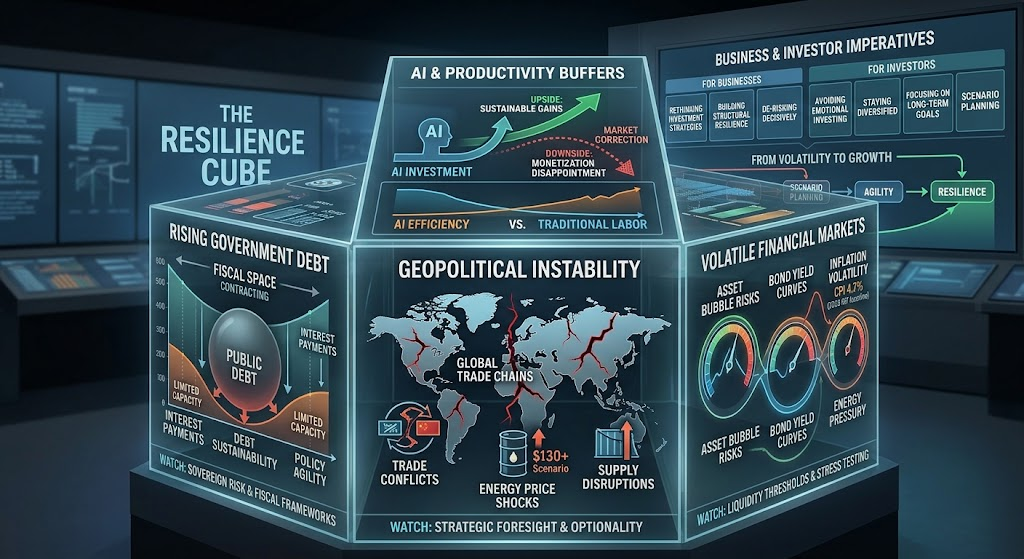
Global Economic Risks 2026: AI, rising government debt, volatile financial markets and geopolitical instability are reshaping the global economic outlook. What should businesses and investors watch?

Table of Contents
Introduction: The global economy is entering a more complicated phase
The global economy is experiencing an unusual combination of technological optimism and financial uncertainty.
Artificial intelligence is attracting unprecedented levels of corporate investment. Technology companies are committing billions of dollars to data centres, advanced processors, cloud infrastructure and AI development.
At the same time, governments are managing high debt levels, financial markets are reassessing asset valuations, and geopolitical conflicts are creating uncertainty around energy, trade and investment.
These developments raise an important question:
Is the global economy entering a new productivity revolution, or are investors building expectations that may prove difficult to sustain?
The answer is not necessarily one or the other. AI could deliver substantial long-term economic benefits while individual companies, investment funds or financial markets experience significant corrections.
Understanding this distinction is essential for businesses, investors, entrepreneurs and policymakers.
1. AI investment: A technological revolution with a financial risk
AI investment has expanded beyond software development.
The current investment cycle includes:
- Advanced semiconductor manufacturing.
- Data-centre construction.
- Cloud computing infrastructure.
- Electricity generation and transmission.
- Cooling systems and water infrastructure.
- AI models and enterprise applications.
- Robotics and industrial automation.
The scale of investment creates opportunities for technology companies, infrastructure providers, energy businesses and specialist service providers.
However, it also creates financial exposure.
On 2 November 2026, European Central Bank Vice-President Boris Vujčić identified elevated AI-stock valuations, stress in government bond markets and possible losses at investment funds as important financial-stability risks.
The ECB also indicated that its next Financial Stability Review would be published on 18 November 2026.
Separately, the IMF’s October 2026 analysis examined the financial vulnerabilities associated with AI investment.
Its research highlighted a particularly important issue: interconnected financing arrangements between AI companies, investors and infrastructure providers.
The IMF examined 14 such transactions since 2023, involving approximately:
- $300 billion in equity investments.
- $650 billion in debt.
- $1.4 trillion in future revenue commitments.
These figures relate to the transactions examined in the IMF’s analysis, not the entire global AI industry.
The concern is that financial stress at one important company could affect other businesses and investors connected to the same investment ecosystem.
The key distinction: High AI investment is not automatically evidence of a bubble. The risk arises when financial valuations and debt commitments depend on future revenues that may not materialise at the expected scale.
2. Why investors are questioning AI valuations
The valuation of a technology company depends partly on expectations about its future earnings.
AI companies may be valued on the assumption that:
- Demand for computing capacity will continue increasing.
- Businesses will pay for AI services at scale.
- AI products will generate sustainable recurring revenue.
- Infrastructure investments will eventually deliver sufficient returns.
- Competitive advantages will remain defensible.
However, several uncertainties remain.
A. High infrastructure costs
AI systems require substantial computing capacity, electricity, cooling and specialised hardware.
The cost of operating advanced AI systems may limit profitability, particularly where customers are unwilling to pay prices sufficient to cover infrastructure expenditure.
B. Uncertain monetisation
A company may attract millions of AI users without generating enough revenue to justify its operating and infrastructure costs.
User adoption, commercial demand and profitability are different measures.
C. Competition and commoditisation
As more companies develop AI models and competing products, pricing pressure could increase.
Technology that currently offers a competitive advantage may become widely available.
D. Dependence on a small number of infrastructure providers
Concentrated dependence on major chipmakers, cloud platforms and energy suppliers can create vulnerabilities throughout the technology ecosystem.
The commercial success of AI will ultimately depend on whether it produces measurable value beyond technological demonstrations.
3. Government debt and rising bond yields: A second source of financial pressure
AI valuations are not the only concern.
Governments around the world have accumulated substantial public debt.
Higher borrowing requirements can create pressure on bond markets, particularly when investors demand greater returns to compensate for inflation, fiscal uncertainty or credit risk.
Government bond yields matter because they influence borrowing costs across the economy.
Higher yields can affect:
- Mortgage rates.
- Corporate borrowing.
- Government debt servicing.
- Infrastructure investment.
- Startup financing.
- Consumer credit.
- Equity valuations.
When government borrowing becomes more expensive, businesses may also face higher financing costs.
This can discourage investment and delay expansion plans.
The relationship is particularly important for emerging markets, where changes in international interest rates and investor risk appetite can influence capital flows and exchange-rate stability.
4. Geopolitical instability is adding another layer of economic uncertainty
Economic decisions are increasingly influenced by political developments.
The conflict involving Iran and the United States has demonstrated how disruptions to strategically important shipping routes can influence international energy prices.
Other geopolitical factors include:
- Trade restrictions and tariffs.
- Technology export controls.
- Regional military tensions.
- Sanctions and counter-sanctions.
- Competition over critical minerals.
- Supply-chain restructuring.
- International investment restrictions.
These developments can increase the cost of doing business even when companies are not directly involved in the conflict.
For example, a manufacturer in Pakistan may face higher energy costs because of a conflict in the Middle East, while simultaneously facing more expensive imported machinery due to exchange-rate pressure.
This is the interconnected nature of modern economic risk.
5. The global economy: Three possible scenarios
The following are analytical scenarios, not forecasts.
Scenario A: Productive AI expansion
AI adoption generates measurable productivity improvements.
Businesses use automation to improve output, reduce errors and develop new products.
Technology companies successfully convert investment into recurring revenue.
In this scenario:
- Productivity improves.
- New industries emerge.
- Business margins may strengthen.
- Employment shifts towards higher-value tasks.
- Investment becomes more closely aligned with actual demand.
Scenario B: Financial correction without technological collapse
Investors become less optimistic about AI-related valuations.
Some technology companies experience falling share prices, while weaker infrastructure projects face funding difficulties.
However, AI adoption continues because the technology remains useful.
Possible consequences include:
- Lower technology valuations.
- Reduced venture capital availability.
- Delayed infrastructure projects.
- Increased scrutiny of AI profitability.
- More disciplined corporate investment.
This scenario would demonstrate that a correction in investment expectations does not necessarily mean the underlying technology has failed.
Scenario C: Multiple shocks reinforce one another
AI investment slows while government borrowing costs remain high and geopolitical disruptions push energy prices upwards.
This combination could affect:
- Corporate profitability.
- Investment confidence.
- Consumer spending.
- Emerging-market currencies.
- International capital flows.
- Employment and business expansion.
This is the most challenging scenario for companies with high debt, limited cash reserves or concentrated supply chains.
6. What does this mean for Pakistan?
Pakistan is particularly exposed to international economic developments through energy imports, foreign exchange, external financing and international trade.
Several channels deserve attention.
Exchange-rate exposure
Higher global risk aversion can reduce investment flows towards emerging markets.
This can create pressure on currencies and foreign-exchange reserves, although domestic fundamentals and policy decisions remain important.
Energy costs
Higher international oil and LNG prices can increase import expenditure and production costs.
This may affect transportation, manufacturing and household purchasing power.
Technology investment
Pakistan’s technology and services businesses could benefit from growing demand for AI-related services, software development, digital transformation and business-process automation.
However, companies need appropriate infrastructure, skilled workers, reliable connectivity and international competitiveness.
Financing costs
Global financial conditions influence the availability and cost of international capital.
Businesses planning expansion should assess financing assumptions rather than relying on optimistic borrowing-cost expectations.
7. What should entrepreneurs and business owners do?
The most useful response is not to stop investing. It is to invest more intelligently.
An AI investment assessment framework
Before purchasing or implementing an AI solution, businesses should ask:
- Which specific business problem does it solve?
- What is the current cost of performing this activity?
- How much time or money could realistically be saved?
- What implementation and subscription costs are involved?
- What data-security risks exist?
- Does the business have the necessary employee skills?
- How will performance be measured?
- What happens if the service becomes unavailable or more expensive?
A financial resilience checklist
Businesses should also:
- Monitor cash flow and working capital.
- Review debt exposure and repayment obligations.
- Avoid excessive dependence on one customer or supplier.
- Evaluate currency exposure.
- Reassess major capital expenditure decisions.
- Maintain realistic sales and revenue assumptions.
- Develop contingency budgets for higher energy and financing costs.
For startups, the priority should be achieving product-market fit and sustainable unit economics rather than pursuing growth at any cost.
8. Opportunities emerging from economic uncertainty
Periods of disruption can also create new markets.
Potential opportunities include:
AI implementation consulting: Helping SMEs identify suitable AI applications and integrate them into existing workflows.
Energy efficiency: Developing solutions that reduce industrial and commercial energy consumption.
Business continuity: Helping organisations prepare for supplier disruptions, currency volatility and operational shocks.
Financial analytics: Providing cost forecasting, scenario planning and management reporting.
Digital transformation: Supporting businesses that need to improve productivity without making excessive technology investments.
Cybersecurity: Protecting organisations against increasingly sophisticated digital threats.
The strongest opportunities are likely to come from solving practical problems rather than selling technology for its own sake.
Conclusion: The next economic winners will be disciplined, not merely optimistic
The global economy does not face a simple choice between technological progress and financial instability.
Both can exist simultaneously.
AI could transform productivity, healthcare, manufacturing, education and professional services. At the same time, excessive financial leverage, unrealistic valuations, rising debt and geopolitical disruption can create serious risks.
For businesses, the most important lesson is to distinguish between technological potential and commercial performance.
A company that adopts AI without understanding its costs may become less efficient rather than more competitive.
An investor who confuses market enthusiasm with guaranteed future earnings may underestimate financial risk.
A business that ignores geopolitical exposure may discover that events outside its control have a direct effect on its profitability.
The organisations best positioned for the next economic cycle will combine innovation with financial discipline, operational resilience and evidence-based decision-making.
The future belongs not simply to businesses that invest more, but to businesses that understand where, why and how they invest.
Frequently asked questions
1. Is the AI investment boom a financial bubble?
There is no definitive evidence that all AI investment represents a bubble. However, elevated valuations, debt exposure and uncertain future returns create financial risks that investors and regulators are monitoring.
2. Why is the IMF concerned about AI investment?
The IMF has highlighted interconnected investment and financing arrangements, potential leverage and the possibility that disappointing AI returns could affect companies and investors across the financial system.
3. How do rising government bond yields affect businesses?
Higher yields can increase borrowing costs, make investment more expensive and reduce the availability of affordable financing.
4. How can geopolitical conflicts affect businesses outside the conflict region?
Conflicts can disrupt energy supplies, trade routes, shipping, insurance, commodity prices and international investment.
5. What should SMEs do during global economic uncertainty?
SMEs should protect cash flow, monitor input costs, diversify suppliers where practical, assess debt exposure and make technology investments based on measurable returns.
References and further reading
- IMF – Global Financial Markets Face Rising Risks From AI, Bond Yields, and Cyberattacks
- European Central Bank – Financial Stability
- IMF – Global Financial Stability Report
- Bank for International Settlements
- World Bank – Global Economic Prospects
- Reuters – ECB highlights AI valuations and financial risks
DMMS Business Advisory
Are you investing in AI, planning business expansion or reviewing your organisation’s financial and operational risks?
DMMS helps businesses evaluate opportunities, improve operational efficiency and develop practical growth strategies.
Connect with DMMS: https://dmms.pk
WhatsApp: +92 323 8886780


Share your views on it