

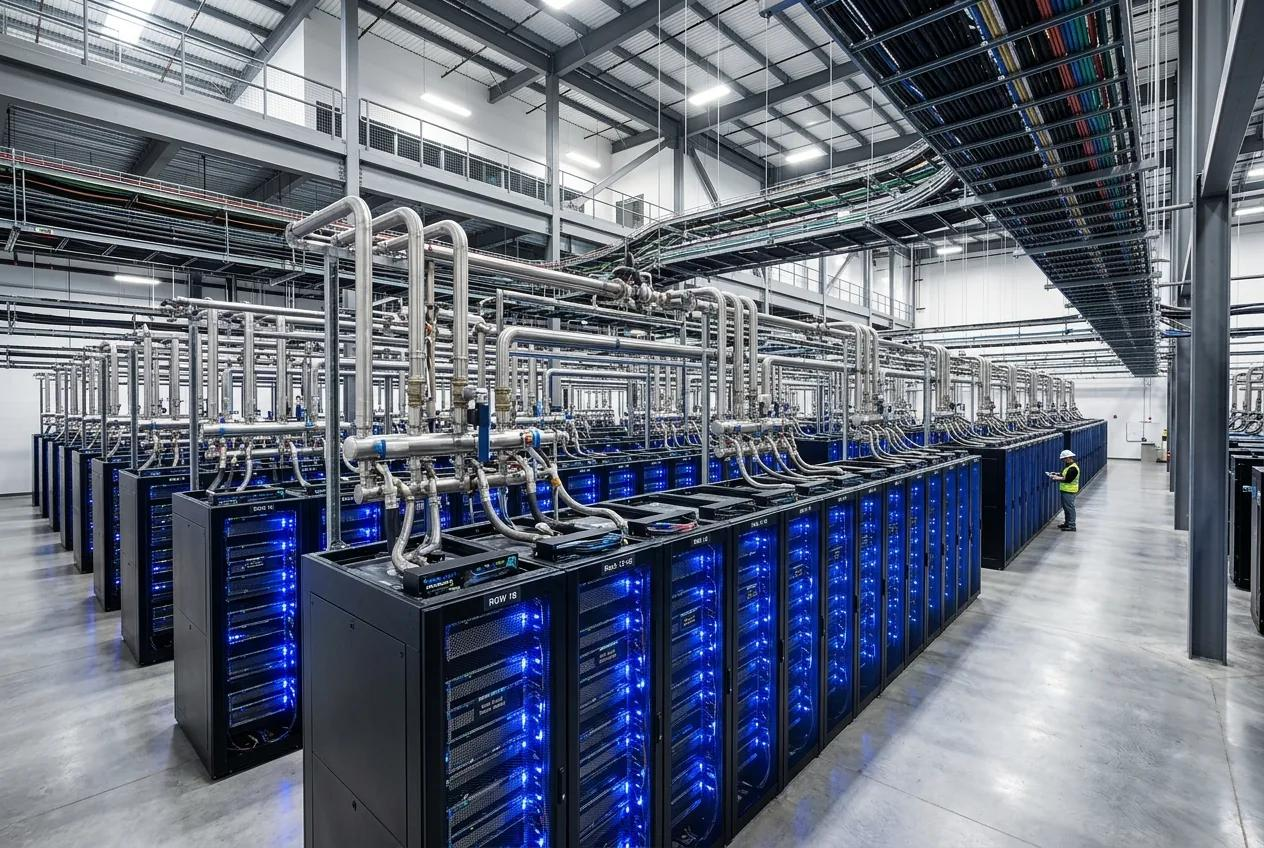
Artificial intelligence is often described as a software revolution. But behind every AI service is physical infrastructure: land, buildings, servers, chips, electricity, cooling systems, water and complex supply chains. As adoption accelerates, the resources required to operate AI are becoming an economic and environmental issue.

Table of Contents
Artificial intelligence is transforming how businesses operate, governments deliver services, professionals make decisions and individuals interact with technology. From generative AI assistants and automated customer support to medical diagnostics, financial forecasting and industrial automation, AI is increasingly becoming part of the global economic infrastructure.
But behind every AI-generated response, image, recommendation or business prediction lies a physical system that requires electricity, water, advanced semiconductors, cooling infrastructure, land and an increasingly complex global supply chain.
This raises an important question: What is the real cost of artificial intelligence, beyond the subscription fee or investment in software?
The rapid expansion of AI is creating a new infrastructure challenge. Data centres require enormous amounts of electricity, cooling systems place pressure on freshwater resources, semiconductor manufacturing consumes energy and water, and the production and disposal of computing hardware create additional environmental burdens.
These costs are not always visible to the businesses and individuals benefiting from AI. Nor are they necessarily borne by the companies developing the technology. In many cases, the environmental and infrastructure consequences are concentrated in the communities and regions hosting data centres, generating electricity or manufacturing components.
The issue is not whether artificial intelligence should be adopted. Its potential benefits are substantial. The more important question is whether the global economy can scale AI responsibly, efficiently and equitably.
For businesses, policymakers and developing economies such as Pakistan, understanding the hidden costs of artificial intelligence is becoming an essential part of digital transformation strategy.
The hidden costs of artificial intelligence are the financial, environmental, infrastructure and social expenses associated with developing, training, operating and maintaining AI systems that are not immediately reflected in the price paid by end users.
These costs include:
- Electricity consumed by AI models and data centres.
- Freshwater used in data-centre cooling and electricity generation.
- Carbon emissions associated with energy consumption and hardware production.
- Semiconductor manufacturing and critical-mineral supply chains.
- Land, grid capacity and infrastructure required for large data centres.
- Electronic waste generated by rapidly replaced computing equipment.
- Economic and social consequences of concentrating resources and infrastructure in particular regions.
The International Energy Agency (IEA) has identified electricity supply as a critical factor shaping the future expansion of AI. Its research shows that data centres consumed approximately 415 terawatt-hours (TWh) of electricity in 2024, equivalent to around 1.5% of global electricity consumption. Under its base-case projection, this could rise to approximately 945 TWh by 2030.
AI is the most important driver of this projected increase, alongside the expansion of other digital services.
Source: International Energy Agency, Energy and AI.
The figures illustrate a fundamental reality: artificial intelligence is not an immaterial digital service. It depends on a rapidly expanding physical infrastructure.
1. The Electricity Problem: AI Needs More Than Computing Power
When people use AI applications, they generally see a simple interface: a question, a prompt, an answer or a generated image.
Behind that interface, however, data centres operate thousands of servers, high-performance processors, networking equipment and storage systems. These facilities must operate continuously and maintain carefully controlled temperatures.
AI workloads are particularly demanding because training and running advanced models require substantial computing capacity.
Why do AI data centres consume so much electricity?
There are several reasons:
High-performance processors: AI models rely on specialised processors, including graphics processing units (GPUs) and other AI accelerators. These components consume substantial power, particularly when operating at high utilisation.
Continuous computing: Once a model is trained, it must still process requests from users. This process, known as inference, can generate significant cumulative electricity demand as AI applications scale.
Cooling systems: Servers generate heat. Data centres therefore require cooling infrastructure, which adds to their electricity consumption.
Redundancy and reliability: Critical facilities need backup power, redundant equipment and systems designed to maintain uninterrupted operations.
The IEA estimates that a typical AI-focused data centre can consume as much electricity as 100,000 households. The largest facilities under construction can require around 20 times as much.
The concentration of these facilities also matters. Even when data centres account for a relatively modest share of global electricity consumption, their impact on individual electricity markets can be significant.
The electricity demand outlook
According to the IEA:
- Global data-centre electricity consumption reached approximately 415 TWh in 2024.
- Data-centre electricity consumption is projected to more than double to approximately 945 TWh by 2030 in its base case.
- The United States and China account for the largest shares of data-centre electricity consumption.
- Grid connection delays, transmission constraints and shortages of critical electrical equipment could affect new data-centre projects.
These projections are not guaranteed outcomes. AI adoption, hardware efficiency, electricity prices, regulation and infrastructure availability will all influence actual demand.
Nevertheless, the direction of travel is clear: AI growth is increasingly dependent on the ability of energy systems to supply reliable electricity.
Source: IEA – Energy and AI: Executive Summary.
Why this matters for businesses
Electricity is becoming a strategic consideration in the economics of AI.
Companies investing in AI infrastructure must consider not only the purchase price of computing equipment but also electricity contracts, cooling systems, backup power, grid access and long-term operating expenses.
For countries competing to attract data-centre investment, reliable electricity is becoming an important determinant of digital competitiveness.
The next phase of the AI race may therefore be shaped as much by energy infrastructure as by software innovation.
2. The Water Footprint: The Environmental Cost We Rarely See
Electricity is only part of the problem. Water is another increasingly important resource in the AI infrastructure equation.
High-performance servers generate considerable heat. Depending on their design, data centres use different cooling systems to maintain safe operating temperatures. Some facilities rely on evaporative cooling, which can consume substantial quantities of freshwater.
Water is also used indirectly in electricity generation and in the manufacturing of advanced semiconductors.
This means the water footprint of AI extends beyond the water used inside a data centre.
How does artificial intelligence consume water?
There are three major sources:
Direct cooling: Water may be evaporated to remove heat from data-centre equipment. The volume required depends on cooling technology, climate, facility design and workload.
Electricity generation: Some power-generation technologies require water for cooling and other processes. Consequently, the electricity consumed by AI infrastructure can carry an indirect water footprint.
Semiconductor manufacturing: Advanced chip production requires highly controlled manufacturing environments and ultrapure water for cleaning and processing silicon wafers.
The distinction between water withdrawal and water consumption is important. Withdrawal refers to water taken from a source, while consumption refers to the portion that is not returned to the same water system in a usable form.
A facility’s total water withdrawal should therefore not automatically be described as its net water consumption.
Why the water footprint deserves attention
A 2026 review published in Water Research examined the water footprint of AI infrastructure and highlighted the combined effects of data-centre cooling, electricity generation and semiconductor manufacturing.
The study estimated that AI’s global water footprint could reach 4.2–6.6 billion cubic metres by 2027. This is a research estimate, not a directly measured global total, and depends on assumptions about the expansion and operation of AI infrastructure.
The research also highlighted the importance of water-stressed regions in the global data-centre expansion.
The United Nations University Institute for Water, Environment and Health also published a 2026 report examining AI’s carbon, water and land footprints. Its central argument is that environmental costs are shaped by where infrastructure is located, how electricity is generated and how resources are managed.
Source: United Nations University – Environmental Cost of Artificial Intelligence.
The Pakistan connection: Why water-intensive digital infrastructure needs careful planning
Pakistan provides an important example of why the geographical distribution of AI infrastructure matters.
The country faces serious water-management challenges, including pressure on freshwater resources, groundwater depletion, agricultural demand and climate-related uncertainty.
The World Bank’s freshwater stress indicator, based on FAO data, reported Pakistan’s most recent available value as 109.99 for 2022. This indicator measures freshwater withdrawals as a proportion of available freshwater resources. It is not a direct measurement of the water available to an individual data centre, but it highlights the broader national water-management challenge.
Source: World Bank – Level of Water Stress: Pakistan.
As Pakistan explores digital infrastructure, cloud services, AI adoption and technology-sector investment, water availability should form part of infrastructure planning.
The question should not simply be whether a data centre can be built. It should also be whether the location has sufficient sustainable water resources, whether alternative cooling technologies are viable and whether local communities could face additional pressure.
Digital development should not create a new competition between technology infrastructure, agriculture and essential household water requirements.
3. Carbon Emissions: Is Artificial Intelligence Increasing the Climate Burden?
Artificial intelligence is often presented as a technology that can help solve environmental problems.
AI can support climate modelling, energy optimisation, smart agriculture, predictive maintenance, transport planning and renewable-energy forecasting.
However, the technology itself also creates environmental costs.
The carbon footprint of AI depends on several factors:
- The electricity source used by the data centre.
- The energy required to train and operate the model.
- The efficiency of the processors and cooling infrastructure.
- The carbon emissions associated with manufacturing servers and semiconductors.
- The lifespan and disposal of computing equipment.
A data centre powered by a relatively low-carbon electricity system will generally have a different emissions profile from an otherwise similar facility relying heavily on fossil fuels.
This makes the geographical location of computing infrastructure particularly important.
Renewable energy does not automatically solve the problem
Technology companies increasingly announce renewable-energy procurement agreements and clean-energy commitments.
These initiatives can contribute to the expansion of renewable generation. However, the environmental performance of a data centre cannot be judged solely by the existence of a renewable-energy contract.
The timing and location of electricity generation matter. A facility may purchase renewable-energy certificates or sign a power purchase agreement while still drawing electricity from a grid that relies on fossil fuels during certain periods.
The IEA’s analysis indicates that renewables are expected to meet nearly half of the additional electricity demand from data centres between 2024 and 2030 in its base case. However, natural gas and coal are also expected to play a significant role in meeting near-term demand.
Source: IEA – Energy Supply for AI.
This creates an important challenge for climate policy: AI infrastructure must grow alongside cleaner and more reliable energy systems, rather than simply increasing demand on existing grids.
The lifecycle emissions problem
Operational electricity is not the only source of emissions.
The production of GPUs, servers, networking equipment, cooling systems and buildings also creates embodied emissions.
A 2026 review in Nature Reviews Clean Technology highlighted that embodied emissions can account for more than half of the emissions associated with large AI data centres in some assessments.
The review also identified a trade-off between water and energy efficiency: cooling approaches that reduce water consumption may increase electricity use or carbon emissions under certain conditions.
This is why sustainability cannot be measured through a single indicator.
Source: Nature Reviews Clean Technology – Strategies and Design for Increasing AI Sustainability.
4. Semiconductor Manufacturing: The Supply Chain Behind the AI Revolution
The AI boom is also reshaping global semiconductor markets.
Advanced AI systems depend on specialised chips, high-bandwidth memory, advanced packaging, networking equipment and sophisticated manufacturing processes.
These components are not produced by a single company or country. They depend on an interconnected international supply chain involving semiconductor designers, foundries, equipment manufacturers, chemical suppliers and logistics networks.
The concentration of advanced manufacturing capacity creates economic and geopolitical vulnerabilities.
Why semiconductor production matters
Semiconductor manufacturing requires:
- Highly specialised fabrication facilities.
- Advanced manufacturing equipment.
- Ultra-pure water and controlled production environments.
- Electronic-grade chemicals and materials.
- Reliable electricity.
- Skilled technical labour.
The production of advanced chips is therefore both capital-intensive and resource-intensive.
As demand for AI accelerators increases, competition for manufacturing capacity and critical components can affect prices, delivery schedules and investment decisions across the technology sector.
A 2026 analysis by the Center for Strategic and International Studies (CSIS) highlighted the substantial role of semiconductors in data-centre investment costs. Its analysis of the US market estimated that semiconductors account for approximately 54 cents of every dollar spent on data-centre infrastructure.
The report also explained how tariffs and trade restrictions could increase the cost of building AI infrastructure.
Source: CSIS – The Impact of Tariffs on the AI Data Center Buildout.
The geopolitical dimension
The AI economy is increasingly influenced by competition over:
- Advanced semiconductor manufacturing.
- Export controls and technology restrictions.
- Critical minerals and electronic-grade materials.
- Data-centre infrastructure.
- Access to reliable energy.
- Skilled technical talent.
This makes AI more than a technology-sector issue. It is becoming a matter of industrial policy, economic security and international competitiveness.
For developing countries, the challenge is not merely to adopt AI applications but to determine how they can participate in the value chain without becoming entirely dependent on foreign technology and infrastructure.
5. The Financial Cost: Who Pays for the AI Infrastructure Boom?
The global AI investment race is often discussed in terms of market capitalisation, venture funding and projected productivity gains.
Less attention is paid to the financial commitments required to build and operate the infrastructure supporting these ambitions.
Data centres require large capital investments in land, buildings, electricity supply, cooling equipment, servers, networking and backup systems.
The costs do not end when construction is complete.
Operators must continue paying for electricity, maintenance, equipment replacement, security, connectivity and compliance.
Why AI infrastructure is expensive
The principal cost categories include:
- Capital expenditure: Land, construction, servers, GPUs, storage and networking equipment.
- Energy expenditure: Electricity for computing, cooling and supporting infrastructure.
- Water and cooling: Water supply, cooling equipment, treatment and recycling systems.
- Hardware replacement: Upgrading equipment as computing requirements change.
- Connectivity: High-capacity networks and low-latency connections.
- Risk management: Cybersecurity, disaster recovery, redundancy and regulatory compliance.
These expenses can create significant barriers to entry.
Large technology companies with access to capital, infrastructure partnerships and global supply chains have advantages over smaller competitors.
The result may be a concentration of AI infrastructure and computing power among a relatively small number of companies.
The business question: Does every organisation need expensive AI infrastructure?
No.
Most businesses do not need to build their own data centres or train large language models from scratch.
For many organisations, using existing AI platforms, smaller specialised models, cloud-based tools or automation systems will be more economically rational.
The correct investment decision should be based on measurable business outcomes rather than the pressure to adopt AI simply because competitors are doing so.
Businesses should assess:
- What problem is AI expected to solve?
- How much time or money will it save?
- What are the implementation and operating costs?
- What data will the system require?
- What are the cybersecurity and compliance implications?
- Can the same result be achieved with a smaller or more efficient system?
AI adoption without a business case can turn a productivity investment into an unnecessary recurring expense.
6. Electronic Waste: The Hardware Disposal Challenge
AI infrastructure requires powerful computing equipment, and technological improvements can make existing hardware less competitive over time.
As organisations upgrade processors, servers and storage systems, older equipment must be reused, refurbished, recycled or disposed of.
This creates an electronic-waste challenge.
Computing equipment contains valuable materials, but it may also contain substances that require careful handling. Improper disposal can contribute to soil and water contamination and create risks for workers involved in informal recycling.
The issue extends beyond data centres. The expansion of AI-enabled devices, consumer electronics and connected systems can also increase demand for hardware.
Responsible AI development should therefore include the full lifecycle of computing equipment:
- Procurement and material sourcing.
- Energy-efficient operation.
- Repair and refurbishment.
- Hardware reuse.
- Certified recycling.
- Safe disposal of non-recoverable components.
The environmental impact of AI cannot be assessed accurately if the analysis stops when a server leaves the data centre.
7. AI Efficiency: Can Technology Reduce Its Own Environmental Footprint?
The environmental costs of AI are real, but they are not necessarily fixed.
Improvements in hardware, software, data-centre design and energy management can reduce the resources required to deliver AI services.
Several approaches deserve attention.
Smaller and specialised AI models
Not every business task requires the most advanced general-purpose model.
A smaller model designed for a specific task may deliver an adequate result while using fewer computing resources.
Organisations can improve efficiency by matching model capability to the complexity and importance of the task.
Better workload management
AI training and other flexible computing workloads can sometimes be scheduled when renewable electricity is more readily available or when grid demand is lower.
This can help reduce pressure on electricity systems and improve the carbon performance of computing.
Improved cooling technologies
Direct liquid cooling, immersion cooling, heat recovery and water-reuse systems may reduce resource consumption, depending on facility design and local conditions.
No cooling solution is universally best. Operators must assess electricity, water, climate and infrastructure trade-offs together.
Hardware reuse and longer equipment lifecycles
Extending the useful life of computing equipment, using refurbished components where technically appropriate and improving recycling can reduce embodied environmental impacts.
Measuring environmental performance
AI developers and infrastructure operators should report more than headline claims about renewable-energy purchases.
Useful indicators include:
- Electricity consumption in kWh or MWh.
- Power Usage Effectiveness (PUE).
- Water Usage Effectiveness (WUE).
- Carbon emissions across the electricity and hardware lifecycle.
- Water withdrawal and water consumption.
- Hardware utilisation and equipment lifespan.
- Electronic-waste reuse and recycling rates.
The 2026 review in Nature Reviews Clean Technology discusses several of these efficiency approaches and the trade-offs between them.
Source: Strategies and Design for Increasing AI Sustainability.
8. What Does the AI Infrastructure Challenge Mean for Pakistan?
Pakistan is at an important stage in its digital transformation.
Businesses are exploring AI-powered customer service, financial technology, digital marketing, education, software development, logistics and business process automation.
The country also has opportunities to expand technology exports, develop digital skills and attract investment in cloud and computing infrastructure.
However, the benefits of AI adoption will depend on the quality and affordability of supporting infrastructure.
Electricity reliability and affordability
Pakistan’s electricity system faces challenges involving generation costs, transmission capacity, pricing and the financial sustainability of the power sector.
The National Electric Power Regulatory Authority’s FY2024–25 generation performance report highlighted issues including thermal-plant utilisation, generation costs and the financial implications of capacity payments.
Source: NEPRA – Performance Evaluation Report, Generation FY2024–25.
For Pakistan, attracting energy-intensive data-centre investment requires careful assessment of electricity availability and the cost of supplying additional demand.
The objective should be to attract investment that strengthens the digital economy without creating avoidable pressure on households, industries or the national grid.
Water security and location planning
Water availability should be an explicit consideration when evaluating large-scale digital infrastructure projects.
Facilities should be assessed on their water requirements, local water conditions, cooling technologies and potential effects on surrounding communities.
Water-efficient and non-potable-water solutions should be considered wherever technically and environmentally appropriate.
Building local AI capabilities
Pakistan does not need to compete with the world’s largest technology companies by attempting to build the biggest AI models or data centres.
A more practical strategy may involve:
- Developing AI skills and research capacity.
- Supporting local AI startups.
- Encouraging responsible business automation.
- Improving digital infrastructure and cybersecurity.
- Building expertise in AI governance and data protection.
- Applying AI to agriculture, healthcare, education and public services.
- Developing specialised AI solutions for local languages and industries.
The economic opportunity lies not only in owning infrastructure but also in creating useful applications, skilled employment, local expertise and exportable services.
A strategic opportunity for Pakistani businesses
Small and medium-sized enterprises can benefit from AI without taking on the infrastructure costs associated with developing large models.
Examples include automated reporting, customer-support assistance, document processing, market research, inventory forecasting and internal workflow automation.
The important requirement is a disciplined approach to implementation.
Businesses should evaluate the total cost of ownership, data security, human oversight and measurable returns before committing to AI solutions.
9. The Policy Challenge: Who Is Responsible for the Environmental Cost of AI?
The expansion of AI infrastructure raises questions that cannot be resolved by technology companies alone.
Governments must consider how to balance innovation, investment, energy security, water management, environmental protection and public interest.
Several policy measures deserve consideration.
Transparent reporting: Large data-centre operators should disclose meaningful information about electricity use, water consumption, emissions and resource efficiency.
Responsible infrastructure planning: New facilities should undergo appropriate assessments of grid capacity, water availability, land use and environmental impact.
Cleaner electricity supply: Governments and energy providers should support reliable, lower-carbon electricity systems capable of meeting new digital demand.
Water stewardship: Data-centre operators should consider local water conditions and adopt responsible cooling and reuse practices.
Circular hardware management: Procurement policies should encourage repair, refurbishment, reuse and certified recycling.
Accountability across supply chains: Environmental reporting should consider the production and disposal of computing equipment, not only the electricity consumed during operation.
The United Nations University report on AI’s environmental footprint emphasises the importance of transparency, lifecycle responsibility, efficiency and environmental justice.
Source: UNU-INWEH – Environmental Cost of Artificial Intelligence.
10. The Future of AI: Innovation Must Be Measured by More Than Intelligence
The global AI race is frequently measured through model performance, computing capacity, investment levels and the speed of technological breakthroughs.
These measures are important, but they do not tell the complete story.
A genuinely successful AI ecosystem must also demonstrate that it can operate efficiently, manage environmental resources responsibly, protect communities and deliver measurable economic value.
The next stage of AI competition may therefore involve a different set of strategic advantages:
- More efficient models.
- Lower-resource computing.
- Reliable and cleaner electricity.
- Water-conscious infrastructure.
- Transparent environmental reporting.
- Responsible semiconductor supply chains.
- Stronger governance and accountability.
For businesses, this means AI adoption should become part of a broader sustainability and operational-efficiency strategy.
For governments, it means digital infrastructure planning must be integrated with energy, water, industrial and climate policy.
For technology companies, it means environmental performance should become a measurable part of product and infrastructure development.
The objective should not be to slow innovation. It should be to ensure that the benefits of innovation are not achieved by transferring hidden costs to the environment, public infrastructure or future generations.
The main hidden costs include electricity consumption, freshwater use, carbon emissions, semiconductor manufacturing, data-centre construction, hardware replacement, electronic waste and the infrastructure required to operate AI systems at scale.
2. How much electricity do AI data centres consume?
The International Energy Agency estimated that all data centres consumed approximately 415 TWh of electricity globally in 2024, representing around 1.5% of global electricity consumption. This includes AI and non-AI workloads. Its base-case projection estimates that data-centre electricity consumption could reach approximately 945 TWh by 2030.
3. Does artificial intelligence consume water?
Yes. AI infrastructure uses water directly for certain cooling systems and indirectly through electricity generation and semiconductor manufacturing. The amount varies according to the facility, cooling technology, electricity source and location.
4. Is artificial intelligence harmful to the environment?
AI has both environmental benefits and environmental costs. It can help optimise energy systems, agriculture and industrial processes, but it also requires electricity, water, hardware and infrastructure. Its overall environmental impact depends on how it is developed, powered and deployed.
5. Can AI become environmentally sustainable?
AI can become more resource-efficient through smaller models, efficient processors, renewable electricity, improved cooling, workload optimisation, longer hardware lifecycles and transparent environmental reporting. However, efficiency improvements must be evaluated against the growth in total AI usage.
6. Why is AI’s environmental impact important for Pakistan?
Pakistan faces challenges involving electricity affordability, grid reliability and water security. Large-scale AI infrastructure could create additional resource demands. Responsible planning is therefore essential to ensure that digital investment supports economic development without placing unnecessary pressure on public resources.
7. What can businesses do to reduce the environmental cost of AI?
Businesses can select appropriately sized AI models, avoid unnecessary automated workloads, assess cloud providers’ sustainability practices, monitor usage, protect data and evaluate AI projects against measurable business outcomes.
8. Is using an AI chatbot environmentally expensive?
Every AI request requires computing resources, but the environmental impact of an individual interaction depends on the model, hardware, response length, data-centre efficiency and electricity source. There is no single reliable environmental cost that applies to every AI query.
Conclusion: The Real Price of Artificial Intelligence
Artificial intelligence is becoming one of the most influential technologies of the modern economy. Its ability to improve productivity, accelerate research, support decision-making and transform industries is difficult to ignore.
But the AI revolution is also creating new demands on electricity systems, freshwater resources, semiconductor supply chains and environmental infrastructure.
The hidden costs of AI should not be treated as an argument against technological progress. They should be treated as a business, economic and governance challenge that requires better measurement and more responsible decisions.
For Pakistan and other developing economies, the opportunity is to participate in the AI economy strategically: build skills, encourage innovation, support local businesses and attract responsible investment while protecting essential resources.
The future of artificial intelligence should not be measured only by how intelligent machines become, but also by how responsibly the systems supporting them are built and operated.
Artificial intelligence can create measurable business value, but successful implementation requires more than purchasing software or experimenting with automation tools.
Businesses need a clear strategy, appropriate technology, efficient workflows, data governance and a realistic assessment of costs and risks.
Multiple Management Solutions (DMMS) supports organisations with business strategy, digital transformation, process improvement, digital marketing and management consultancy.
If your organisation is exploring AI adoption, automation or digital transformation, DMMS can help you assess opportunities, identify operational priorities and develop a practical implementation roadmap.
Discuss your business requirements with DMMS:
- Website: https://dmms.pk/
- WhatsApp: https://wa.me/923238886780
- Contact: +92 323 888 6780
Start with the business problem. Evaluate the technology. Measure the results.


