


Table of Contents
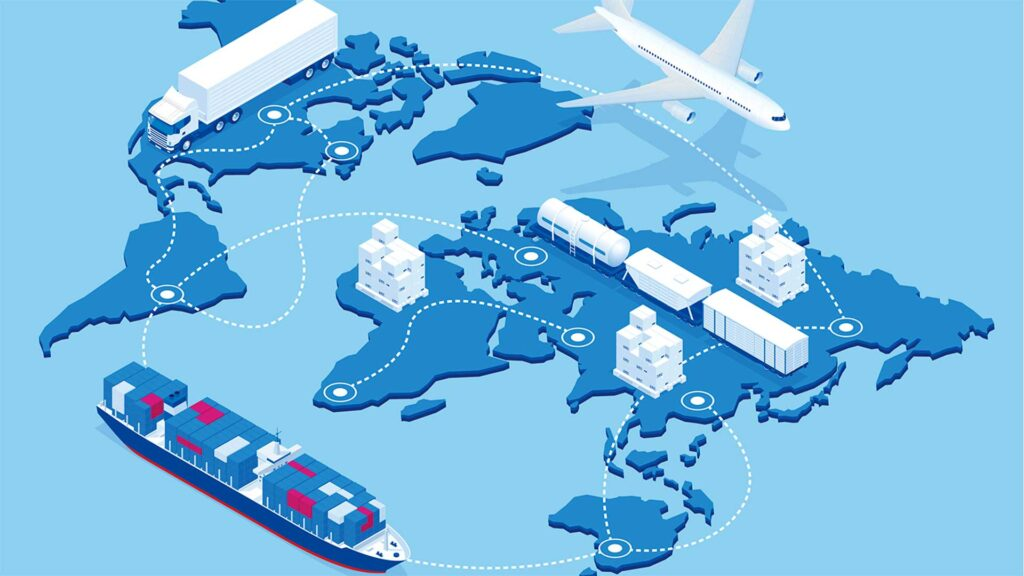
For decades, businesses organised supply chains around a straightforward principle: source from the most competitive supplier, manufacture where costs are lowest and sell wherever demand exists. That model has not disappeared, but it is becoming more complicated.
Geopolitical tensions, trade restrictions, shipping disruptions, energy insecurity and tougher product standards are changing how companies evaluate suppliers and markets. Businesses increasingly ask not only where they can buy at the lowest price, but whether they can still obtain a critical input if a political or logistics crisis occurs.
What is changing in global supply chains?
Trade is becoming more geopolitically selective
Governments increasingly use trade, finance, technology and industrial policy to pursue economic and national-security objectives. Companies must monitor tariffs, sanctions, export controls, local-content rules and market-access requirements alongside ordinary commercial factors.
Companies are diversifying suppliers
Common approaches include China Plus One, nearshoring, friend-shoring, dual sourcing and regionalisation. These strategies reduce concentration risk but may increase procurement costs, qualification work and operational complexity.
Shipping and energy risks matter more
Maritime chokepoints, conflict-related disruption and higher insurance costs can change delivery times and landed costs. A low factory price may cease to be attractive once freight, insurance, duties, delays and inventory financing are included.
Compliance is a competitive requirement
Depending on the product and destination, buyers may require traceability, labour and workplace compliance, environmental disclosures, product certification, cybersecurity controls and supplier documentation. Smaller firms can lose opportunities when they cannot demonstrate compliance.

What does this mean for Pakistan?
Textiles and apparel
International buyers seeking supplier diversification may consider Pakistani manufacturers. To benefit, exporters need consistent quality, reliable delivery, transparent sourcing, compliance documentation and competitive productivity.
Agriculture and food processing
Rice, processed foods, fruits and vegetables can benefit from stronger distribution networks. Food safety, cold-chain infrastructure, packaging and certification remain essential.
Engineering and light manufacturing
Surgical instruments, sports goods, auto parts and selected engineering products may find opportunities where buyers want alternative suppliers. The challenge is to compete on reliability and technical capability, not price alone.
Digital services
Supply-chain redesign also creates demand for software, data management, procurement support, logistics coordination, cybersecurity and business-process services. Pakistani firms can participate without building physical factories.
Why lowest-cost sourcing is no longer enough
Total landed cost includes purchase price, freight, insurance, duties, handling, financing and expected disruption costs. A supplier offering a lower unit price may be more expensive overall if its route is unreliable or lead times are unpredictable.
Evaluate suppliers on price, delivery reliability, quality, political and logistics exposure, financial stability, regulatory compliance and availability of alternatives.
A practical resilience checklist for SMEs
- Map critical inputs and identify their country and supplier concentration.
- Qualify a second supplier for business-critical materials where feasible.
- Calculate total landed cost rather than comparing quotations alone.
- Maintain realistic safety stock for critical inputs.
- Review contracts for force majeure, delivery and price-adjustment provisions.
- Monitor currency, freight, energy and insurance exposure.
- Digitise purchase orders, inventory records and supplier documentation.
- Prepare contingency plans for delayed shipments or unavailable inputs.
SMEs do not need expensive enterprise software to begin. A structured spreadsheet, supplier register and monthly risk review can provide a useful starting point.
Business opportunities emerging from supply-chain redesign
Demand may grow for export-readiness and compliance advisory, supplier identification, procurement support, inventory optimisation, logistics coordination, quality assurance and digital supply-chain documentation. Pakistani businesses should aim to become reliable, transparent and easy to work with.
Frequently asked questions
Is globalisation ending?
No. Global trade remains extensive, but strategic dependencies, resilience and regulation increasingly influence where companies source and invest.
What is friend-shoring?
Friend-shoring means sourcing or locating production in countries considered politically or strategically reliable.
How can Pakistani SMEs benefit?
They can strengthen quality assurance, export compliance, delivery systems, customer diversification and digital documentation.
Conclusion
Future supply chains will not necessarily be the cheapest. They will balance cost, reliability, compliance and adaptability. Pakistan can benefit from changing trade patterns if businesses invest in productivity, logistics, quality and market intelligence.
Need help improving operational resilience or export readiness? DMMS Business Advisory supports businesses with strategic planning, process improvement and operational systems. Visit dmms.pk or contact DMMS on WhatsApp at +92 323 8886780.
Sources and further reading
- UN Trade and Development (UNCTAD)
- World Trade Organization
- World Bank — Trade
- International Maritime Organization
Editorial note: Trade statistics and projections should be checked against the latest UNCTAD and WTO releases before publication; values and forecasts may be revised.


