

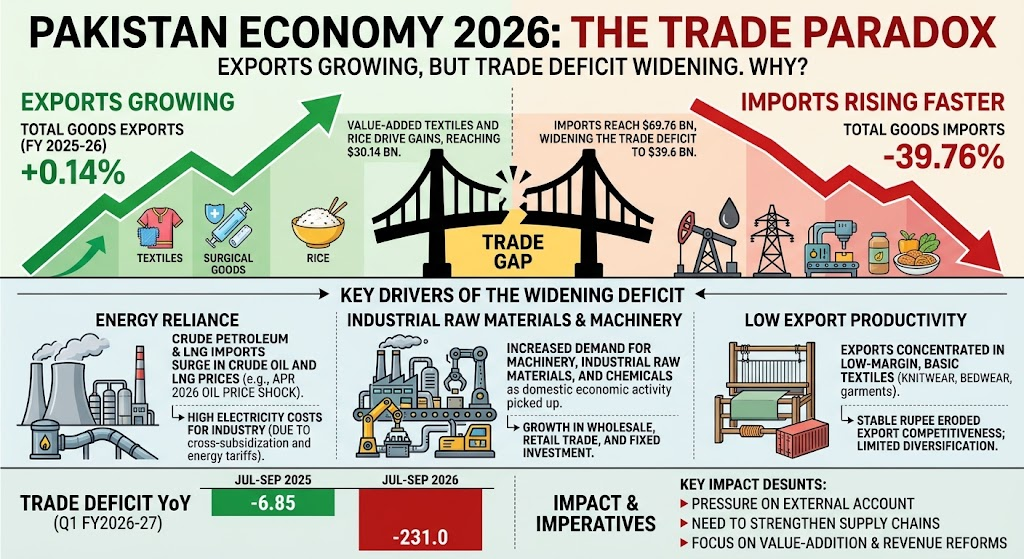
Pakistan Trade Deficit 2026: A closer look at Pakistan’s July–September trade performance, rising imports, export competitiveness and the structural challenges facing the economy.

Table of Contents
Introduction: Growing exports do not automatically mean a stronger economy
Pakistan’s latest trade statistics present an important economic question.
Exports are increasing. Pakistani products continue to reach international markets, and several major export categories are showing growth.
Yet imports are increasing even faster.
According to the Pakistan Bureau of Statistics (PBS), Pakistan exported approximately US$8.445 billion worth of goods during July–September 2026, compared with US$7.599 billion during the same period in 2025.
This represents an increase of 11.13%.
However, imports increased to approximately US$19.213 billion, compared with US$16.973 billion a year earlier, representing growth of 13.20%.
The result was a merchandise trade deficit of approximately US$10.768 billion, compared with US$9.374 billion during the corresponding period of the previous year.
The numbers highlight an important distinction:
An economy can experience export growth while its external trade imbalance continues to deteriorate.
Understanding why requires examining both sides of Pakistan’s international trade.
1. Pakistan’s latest trade performance: What do the numbers tell us?
The following figures are based on the Pakistan Bureau of Statistics’ provisional September 2026 advance release.
Pakistan’s merchandise trade: July–September 2026
| Indicator | July–September 2026 | July–September 2025 | Growth |
|---|---|---|---|
| Exports | $8.445bn | $7.599bn | +11.13% |
| Imports | $19.213bn | $16.973bn | +13.20% |
| Trade deficit | $10.768bn | $9.374bn | +14.87% |
Figures are provisional and may be revised.
Three conclusions emerge.
First: Export growth is encouraging.
Second: Imports are growing faster than exports.
Third: The absolute trade deficit has increased by approximately US$1.394 billion.
This matters because Pakistan needs sufficient foreign-exchange earnings to finance imports and meet its external payment obligations.
2. What is driving Pakistan’s export performance?
Pakistan’s exports are concentrated in several major sectors, particularly textiles, clothing, agricultural products and related manufactured goods.
The September 2026 PBS release identifies the following major export categories:
- Knitwear.
- Readymade garments.
- Bedwear.
- Cotton cloth.
- Rice.
- Towels.
- Made-up textile articles.
- Petroleum products.
- Cotton yarn.
Textiles remain especially important because of their contribution to employment, manufacturing activity and foreign-exchange earnings.
The September figures also show growth in selected products compared with September 2025.
For example:
- Readymade garments increased by 18.51% in value.
- Basmati rice increased by 168.88%.
- Other rice increased by 131.18%.
- Towels increased by 15%.
These are commodity-specific value changes, not necessarily equivalent increases in export volumes. Prices, product mix and exchange-rate movements can influence export values.
The challenge: Export concentration
Reliance on a relatively limited range of products and markets creates vulnerability.
A decline in international textile demand, changes in cotton prices, higher production costs or competition from other exporting countries can affect national export performance.
Pakistan needs to strengthen both existing industries and emerging export sectors.
Potential areas include:
- Information technology and digital services.
- Engineering products.
- Pharmaceuticals.
- Processed food.
- Higher-value agricultural products.
- Technical textiles.
- Specialist manufacturing.
- Business and professional services.
3. Why are imports increasing?
Imports are not automatically bad for an economy.
An important distinction must be made between imports that support productive investment and imports that primarily satisfy consumption.
Pakistan’s September 2026 imports included:
| Major import category | September 2026 value, PKR million |
|---|---|
| Petroleum products | 163,173 |
| Petroleum crude | 143,902 |
| Palm oil | 96,310 |
| Plastic materials | 87,308 |
| Iron and steel | 80,850 |
| Electrical machinery and apparatus | 77,492 |
| Iron and steel scrap | 69,062 |
| Motor cars (CKD/SKD) | 68,149 |
| Raw cotton | 42,040 |
| Mobile phones | 39,751 |
Source: PBS, September 2026 advance release.
These figures illustrate the different economic purposes served by imports.
A. Energy imports
Petroleum and related products are essential for transportation, industrial activity and energy requirements.
Higher international oil prices can increase the import bill even without a corresponding increase in the quantity purchased.
This is especially important during periods of geopolitical disruption.
B. Industrial inputs
Plastic materials, iron and steel, raw cotton and machinery are used in domestic production.
Importing these inputs can support manufacturing, construction and industrial expansion.
However, excessive dependence on imported raw materials can expose businesses to exchange-rate fluctuations and international supply-chain disruption.
Imports of vehicles, mobile phones and other consumer products may reflect domestic demand, changing purchasing power and government import policies.
Their economic impact depends on how they affect foreign-exchange availability, domestic production and employment.
The important issue is not simply whether imports increase.
It is whether the country’s import structure supports sustainable productivity and export capacity.
4. Why is the trade deficit important?
A trade deficit occurs when the value of merchandise imports exceeds the value of merchandise exports.
It is one component of a country’s broader balance of payments.
Pakistan’s trade deficit is important because it creates a requirement for foreign-exchange financing.
However, it should not be confused with the current-account deficit.
The current account also includes services, primary income and secondary income, including remittances.
A country can experience a merchandise trade deficit while maintaining a more manageable current-account position if other external receipts are sufficiently strong.
For Pakistan, remittances, services exports, investment flows and external financing are therefore important parts of the broader economic picture.
5. What happens if imports continue growing faster than exports?
Several risks could emerge.
Pressure on foreign exchange
Higher import payments increase demand for foreign currency.
If export receipts and other foreign-exchange inflows do not keep pace, pressure may develop on reserves and exchange-rate stability.
Currency uncertainty
A widening external imbalance can increase concerns about the sustainability of the exchange rate.
However, the exchange rate also depends on monetary policy, reserves, capital flows, external financing and market expectations.
Higher production costs
Import-dependent industries may face higher costs if the rupee depreciates.
This can affect manufacturing margins and consumer prices.
Inflationary pressure
Higher energy and imported-input costs may feed into transportation, food distribution and retail prices.
Investment uncertainty
Businesses planning major investments may delay decisions if exchange-rate and import-cost assumptions become difficult to predict.
6. Can Pakistan improve its trade position without restricting productive imports?
This is an important policy question.
A simplistic approach would be to reduce imports indiscriminately.
However, industries often require imported machinery, raw materials and technology to increase domestic production.
Restricting productive imports could weaken future export capacity.
A more sustainable approach would involve several complementary measures.
Improve export value addition
Pakistan should move beyond competing primarily through low-cost production.
Higher-value products, improved design, quality standards, technology adoption and reliable delivery can strengthen export competitiveness.
Diversify export markets
Greater market diversification can reduce dependence on a limited number of trading partners.
Businesses should explore opportunities in the GCC, European Union, Central Asia, Africa and Southeast Asia, subject to market-access requirements.
Develop technology and services exports
IT, software development, digital marketing, consulting, professional services and other knowledge-based activities can generate foreign-exchange earnings without relying on traditional merchandise exports.
Reduce energy inefficiency
Energy-efficient industrial processes can improve competitiveness and reduce exposure to imported energy prices.
Improve logistics and trade facilitation
Faster customs processes, efficient ports, reliable transport and digital documentation can reduce the cost of exporting.
7. What does this mean for Pakistani SMEs and entrepreneurs?
The trade figures are not only relevant to policymakers.
They contain practical lessons for individual businesses.
For manufacturers
Review the proportion of imported inputs in total production costs.
Identify opportunities to improve energy efficiency, reduce waste and develop local supplier relationships where commercially viable.
For exporters
Examine product demand, international pricing, certification requirements and delivery reliability.
Export growth is not sustainable if businesses cannot maintain quality and profit margins.
For digital service providers
International demand for software, marketing, design, consulting and other digital services creates opportunities to earn foreign currency.
SMEs should explore how professional digital presence, international positioning and effective client acquisition can support export-oriented services.
For entrepreneurs
Look for products and services where Pakistan has a competitive advantage.
The strongest business opportunities may lie in adding value to existing industries rather than simply increasing the volume of low-margin products.
8. A simple trade-deficit sensitivity exercise
Consider an illustrative example.
Suppose Pakistan’s monthly import bill is US$6 billion.
If import costs increase by 10% while export earnings remain unchanged, the additional monthly import expenditure would be US$600 million.
At a 20% increase, the additional expenditure would be US$1.2 billion.
This is a simplified illustration, not a prediction or an estimate of actual future import costs.
It demonstrates why energy prices, exchange rates and international freight costs deserve close attention.
Businesses can apply the same logic to their own operations by calculating how changes in imported input costs affect production margins and working capital.
9. The indicators Pakistan should monitor over the coming months
A comprehensive assessment of economic performance requires more than one trade report.
The following indicators are particularly important:
| Indicator | Why it matters |
|---|---|
| Monthly exports | Measures external sales performance |
| Monthly imports | Shows foreign-exchange demand |
| Trade balance | Measures merchandise trade gap |
| Current account | Provides broader external-sector picture |
| Foreign-exchange reserves | Indicates external liquidity |
| Remittances | Important source of foreign exchange |
| Exchange rate | Influences import costs and competitiveness |
| Inflation | Measures domestic price pressures |
| Industrial production | Indicates manufacturing activity |
| Policy interest rate | Influences investment and financing costs |
These indicators should be examined together to avoid drawing misleading conclusions from individual data releases.
Conclusion: Pakistan needs export growth that is sustainable, diversified and productive
Pakistan’s July–September 2026 trade performance offers both encouragement and caution.
Exports grew by 11.13%, demonstrating improved foreign sales compared with the previous year.
However, imports increased by 13.20%, and the merchandise trade deficit widened by approximately 14.87%.
The figures do not necessarily indicate an economic crisis. Imports can support investment and productive capacity.
But they highlight a structural challenge: Pakistan needs to generate stronger, more diversified and higher-value export earnings to support sustainable economic growth.
For businesses, this means focusing on productivity, quality, international market access, technology adoption and cost efficiency.
For policymakers, it means creating an environment in which exporting becomes commercially attractive and internationally competitive.
The real measure of economic progress is not simply whether Pakistan imports less or exports more.
It is whether the country can produce more value, compete successfully in international markets and generate sufficient foreign exchange to finance its development.
Frequently asked questions
1. What was Pakistan’s trade deficit in July–September 2026?
According to provisional PBS figures, the merchandise trade deficit was approximately US$10.768 billion.
2. Did Pakistan’s exports increase in 2026?
Yes. Exports reached approximately US$8.445 billion in July–September 2026, an 11.13% increase compared with the corresponding period in 2025.
3. Why is Pakistan’s trade deficit increasing?
Imports increased by 13.20%, faster than export growth of 11.13%. Higher imports of energy, machinery, industrial inputs and other goods contributed to the overall import bill.
4. Is a trade deficit always harmful?
No. Imports of machinery, technology and productive inputs can support future economic growth. The key issue is whether the economy generates sufficient export earnings and other foreign-exchange inflows to finance its external requirements.
5. How can Pakistan improve its trade balance?
By increasing export value addition, diversifying markets, improving industrial productivity, expanding services exports, reducing energy inefficiency and strengthening trade infrastructure.
Sources and references
- Pakistan Bureau of Statistics – September 2026 Advance Release on External Trade
- Pakistan Bureau of Statistics – External Trade Statistics
- Ministry of Commerce – Monthly Review of Trade Statistics
- State Bank of Pakistan
- Pakistan Economic Survey
- World Bank – Pakistan
DMMS Business Advisory
Is your business ready to enter international markets, improve its operational efficiency or develop a more competitive growth strategy?
DMMS supports businesses with strategic planning, digital transformation, marketing and business development.
Website: https://dmms.pk
WhatsApp: +92 323 8886780


Share your views on it