

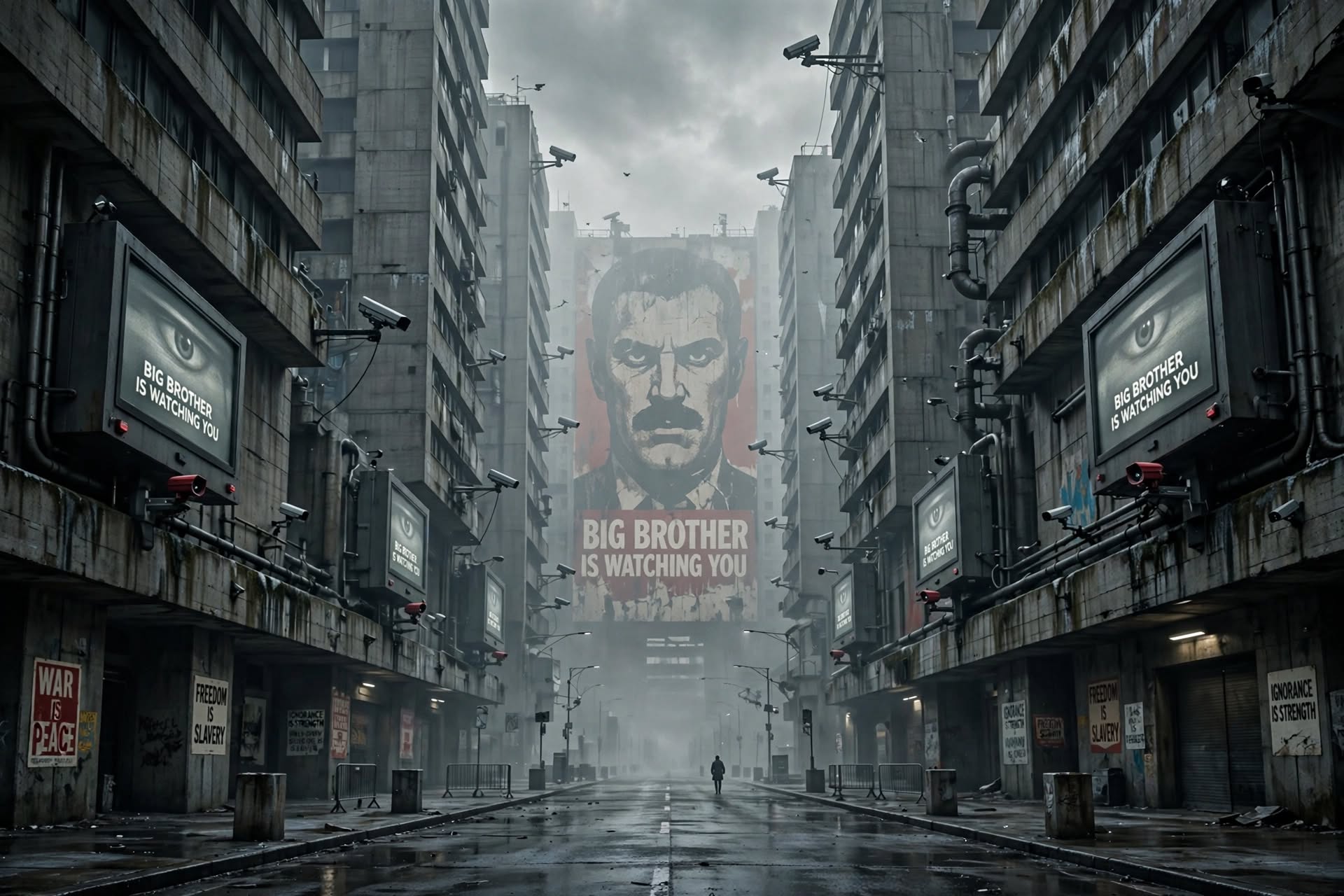
Which book’s world would be the absolute worst to live in?

Imagine waking up in a world where the government watches you, rewrites your memories, controls your language, and eventually makes you love the people destroying you.
That is the nightmare at the heart of George Orwell’s 1984—and the reason its fictional society of Oceania may be one of the most terrifying dystopias ever imagined.
Many fictional worlds are more physically brutal. Some are devastated by famine, ruled by religious extremism, or populated by people who have been conditioned to accept unimaginable cruelty. Yet 1984 presents a uniquely disturbing possibility: a society that does not merely demand obedience but attempts to eliminate the mental freedom required to recognize oppression.
If the question is which fictional dystopia would be the worst place to live—not simply the most frightening to read about—1984 makes a powerful case for first place.
But how does Orwell’s Oceania compare with the devastated landscape of The Road, the reproductive dictatorship of The Handmaid’s Tale, the engineered happiness of Brave New World, and the quiet horror of Never Let Me Go?
Let us compare these fictional worlds through five dimensions: physical survival, personal freedom, psychological control, the possibility of resistance, and the existence of an alternative.
Table of Contents
- Why Is 1984 the Worst Dystopian World to Live In?
- 1. 1984: A World That Controls Your Mind
- 2. The Road: A World Without Hope or Resources
- 3. The Handmaid’s Tale: When the State Owns Your Body
- 4. Brave New World: The Horror of Manufactured Happiness
- 5. Never Let Me Go: A Life Designed for Exploitation
- What About Warhammer 40,000 and I Have No Mouth, and I Must Scream?
- Dystopian Worlds Compared: Which Is the Worst?
- Why Dystopian Fiction Still Matters Today
- Frequently Asked Questions
- Final Verdict: The Worst Kind of Dystopia
Why Is 1984 the Worst Dystopian World to Live In?
1984 is arguably the worst dystopian world to inhabit because it combines pervasive surveillance, psychological manipulation, historical revision, linguistic control, and the systematic destruction of personal identity.
Other dystopias may threaten your life, freedom, or bodily autonomy. Orwell’s Oceania goes further: it seeks to control the standards by which you decide what is true, what is right, and even what you are capable of thinking.
Published in 1949, George Orwell’s novel follows Winston Smith, an ordinary citizen of Oceania who works at the Ministry of Truth, altering historical records to match the ruling Party’s current claims. His private doubts gradually develop into rebellion, but the state’s ultimate objective is not merely to punish him. It is to transform his inner beliefs.
The distinction is crucial. In many oppressive societies, people may secretly disagree with their rulers. In 1984, independent thought itself becomes a threat to the regime.
The novel’s most frightening features are interconnected:
- No meaningful privacy: Surveillance makes private dissent dangerous.
- No reliable language for resistance: Newspeak is designed to narrow the range of expressible thought.
- No trustworthy historical record: The Party manipulates the past to protect its authority.
- No guaranteed inner refuge: Psychological torture targets a person’s deepest fears and attachments.
- No secure sense of reality: The Party demands that citizens accept its claims even when those claims contradict their experience.
The result is a society in which resistance is not simply difficult. The very foundations of resistance—memory, trust, language, identity, and independent judgment—are under attack.
1. 1984: A World That Controls Your Mind {#why-1984-is-the-worst}
No Private Self: Big Brother Is Always Watching
In Oceania, privacy is not a normal human expectation. Telescreens broadcast propaganda while also enabling surveillance, and citizens must assume that their behavior may be observed. The Thought Police enforce ideological conformity, turning even a facial expression or an apparently insignificant gesture into a potential source of suspicion.
This creates a distinctive psychological burden: you cannot know when you are safe enough to be yourself.
Imagine having to monitor every conversation, facial expression, friendship, and emotional reaction. You would not merely hide your opinions. You would begin anticipating how others might interpret them.
The danger extends beyond physical punishment. Surveillance encourages people to censor themselves before an authority figure needs to intervene.
Newspeak: When Language Becomes a Prison
The Party’s linguistic project, Newspeak, is among Orwell’s most influential ideas.
Newspeak is not simply a government-approved vocabulary. It is designed to reduce the range of thought by eliminating words, distinctions, and meanings that could support independent political or philosophical judgment.
If the vocabulary required to articulate a particular idea disappears, expressing that idea becomes harder. Orwell pushes this premise toward its most extreme conclusion: the Party hopes to make unorthodox thought eventually impossible.
Consider the implications of a society that steadily removes the vocabulary of dissent, justice, liberty, and individual rights. People may still experience discomfort or injustice, but they have fewer conceptual tools with which to describe what is happening and organize against it.
Language does not determine every thought a person can have. Nevertheless, it strongly influences how people communicate, reason together, and make complex ideas accessible.
Newspeak turns that relationship into a mechanism of political control.
No Past, No Future: The Destruction of Objective Truth
Winston works at the Ministry of Truth, where documents are altered whenever the Party changes its position. Yesterday’s enemy can become today’s ally, and yesterday’s official promise can disappear without explanation.
The Party’s slogan captures this logic:
“Who controls the past controls the future: who controls the present controls the past.”
Without reliable records, independent journalism, or shared standards of evidence, citizens struggle to challenge official claims.
Suppose you remember a government announcing one policy, but every available record now claims that it announced another. Your memory becomes an isolated, easily dismissed source of evidence.
This is more than ordinary propaganda. It is an attempt to undermine the distinction between fact and authority.
Orwell’s treatment of historical revision remains relevant to discussions about censorship, disinformation, manipulated archives, and the political use of collective memory. The modern comparison is not that every inaccurate statement constitutes totalitarianism, but that independent evidence and the freedom to question official narratives are essential safeguards against abuse.
Room 101: The Destruction of Personal Loyalty
The final horror of 1984 is not simply the possibility of dying in pain. It is the Party’s attempt to destroy Winston’s remaining emotional independence.
In Room 101, prisoners confront what they fear most. Winston’s terror is exploited until he betrays Julia, the person whose relationship with him represented a private world outside the Party’s control.
His eventual surrender is devastating because it attacks the idea that a person can preserve an inviolable inner self, even under extreme coercion.
The Party does not want Winston to comply while secretly hating it. It wants him to accept its authority emotionally and psychologically.
That is the defining horror of 1984: the regime does not consider outward obedience sufficient; it wants ownership of the mind that obeys.
For further reading, consult George Orwell’s 1984 on Encyclopaedia Britannica and the Orwell Foundation.
2. The Road: A World Without Hope or Resources {#the-road-survival}
Cormac McCarthy’s The Road offers a different kind of nightmare. Instead of a powerful government controlling every aspect of life, it presents a devastated world in which the structures that make civilization possible have largely collapsed.
An unnamed father and his young son travel through a barren landscape following an unspecified catastrophe. Food is scarce, the weather is hostile, and the remains of human society offer little protection.
The Physical Horror of Survival
In The Road, the basic requirements of life become daily uncertainties:
- Where will the next meal come from?
- Is there safe drinking water?
- Can you find shelter before the cold becomes dangerous?
- Are the strangers you encounter desperate survivors or immediate threats?
- How long can you protect a child when your own survival is uncertain?
The horror is cumulative. Hunger, exposure, exhaustion, and constant vigilance make even ordinary decisions exhausting.
There is no functioning political system to reform and no reliable authority to appeal to. Survival depends on whatever resources, knowledge, and trust remain.
Can You Still Resist in Your Head?
Unlike Winston Smith, the father and son can retain a private moral identity. The father’s determination to protect his child gives their journey meaning, even when nearly every external source of hope has disappeared.
Yet this freedom is limited. A person may preserve their values while lacking the resources to act on them.
The novel’s central tension is that love survives in a world that increasingly punishes compassion. Protecting another person becomes both a reason to continue living and a source of unbearable vulnerability.
Verdict: The Road may be worse than 1984 in terms of immediate physical survival. But its characters can still distinguish their own values from the horrors surrounding them. The world threatens to destroy their humanity without necessarily gaining ownership of their minds.
Read more about Cormac McCarthy and The Road through Encyclopaedia Britannica.
3. The Handmaid’s Tale: When the State Owns Your Body {#handmaids-tale-autonomy}
Margaret Atwood’s The Handmaid’s Tale imagines the Republic of Gilead, a theocratic authoritarian regime that responds to a fertility crisis by imposing a rigid gender hierarchy.
Women are stripped of many rights, and fertile women known as Handmaids are forced into reproductive servitude.
Where 1984 emphasizes the state’s attempt to control thought, The Handmaid’s Tale makes political power intensely intimate. It enters the home, regulates relationships, controls reproductive choices, and determines which women may bear children and under what circumstances.
Bodily Autonomy Becomes a Political Privilege
For Handmaids, reproduction is not a private decision. It is an obligation enforced through ritual, surveillance, religious rhetoric, and the threat of punishment.
Their names are replaced by patronymic designations, signaling that their social identities have been subordinated to the men who control their households.
The system also separates women according to their assigned functions and privileges. This hierarchy discourages solidarity and makes resistance more dangerous.
The consequences extend beyond physical coercion. Gilead attempts to control the stories women tell about themselves, the relationships they are permitted to maintain, and the futures they are allowed to imagine.
Is There an Outside?
Unlike the apparently closed political universe of Oceania, Atwood’s fictional world contains other countries, and the possibility of escape or external assistance exists in some circumstances.
That does not make Gilead safe. Escape is dangerous, resistance can lead to severe punishment, and many characters have little practical control over their circumstances.
The novel’s horror lies in the way a political system transforms gender, fertility, family, and religion into instruments of domination.
Verdict: The Handmaid’s Tale may be the most disturbing dystopia for someone concerned about reproductive freedom and gender-based oppression. Its violence is systemic, personal, and embodied, while 1984 is especially terrifying for its attempt to erase independent thought itself.
Learn more through Margaret Atwood’s official website and Encyclopaedia Britannica’s discussion of The Handmaid’s Tale.
4. Brave New World: The Horror of Manufactured Happiness {#brave-new-world-happiness}
Aldous Huxley’s Brave New World presents one of the most unsettling alternatives to Orwell’s vision.
In Oceania, the state uses fear, surveillance, and torture to demand obedience. In Huxley’s World State, social stability is maintained through biological engineering, psychological conditioning, consumerism, and the drug soma.
People are conditioned from birth to accept predetermined social roles. Their desires are shaped to fit the system, and discomfort can be suppressed through readily available pleasure.
The result is a society in which many citizens appear content.
What If You Never Wanted Freedom?
This is the central question of Brave New World.
If people are conditioned to enjoy their assigned roles, discouraged from forming destabilizing attachments, and given convenient ways to escape unpleasant emotions, they may never experience their situation as oppression.
A society can therefore suppress freedom without making everyone feel miserable.
The novel explores the costs of trading individuality, meaningful relationships, intellectual depth, and artistic or spiritual ambition for comfort and social stability.
Its citizens are not necessarily subjected to constant physical torture. Instead, the system reduces the incentive to question its assumptions.
Is Happiness Enough?
Huxley’s dystopia challenges the idea that subjective happiness is the only measure of a good society.
A person might feel satisfied while lacking meaningful autonomy, access to truth, or the ability to choose a different life. Conversely, discomfort can sometimes be part of recognizing injustice and working toward change.
This does not mean that happiness is inherently suspicious or that every comfortable society is oppressive. The warning is about happiness manufactured through coercion and the deliberate suppression of alternatives.
Verdict: Brave New World may be the most insidious dystopia because it makes domination feel desirable. 1984 forces people to confront their oppression; Huxley’s society works to prevent that confrontation from occurring in the first place.
For further reading, see Aldous Huxley on Encyclopaedia Britannica and the Huxley family’s official website.
5. Never Let Me Go: A Life Designed for Exploitation {#never-let-me-go}
Kazuo Ishiguro’s Never Let Me Go creates a quieter, more intimate form of dystopian horror.
The novel follows Kathy, Ruth, and Tommy, who grow up in an apparently ordinary English boarding-school environment. Gradually, the truth emerges: they are clones created to provide organs for other people, and their lives are structured around that purpose.
The horror is not confined to a sudden revelation. It develops through the characters’ gradual understanding of a system that has already decided their futures.
The Comfort of a Carefully Managed Reality
The characters experience friendship, jealousy, affection, ambition, and romantic longing. They have memories of school, familiar routines, and relationships that matter deeply to them.
Yet these ordinary experiences unfold within a system that denies them the future most people take for granted.
Their education and social environment do not provide the tools or opportunities needed to overturn their predetermined fate. The gradual revelation of their purpose makes the injustice even more disturbing: the system has become so normalized that resistance appears almost unimaginable.
Why Don’t They Simply Escape?
The characters’ limited resistance should not be mistaken for free and informed acceptance.
Their world restricts what they know, what they can reasonably expect, and which alternatives appear possible. Social conditioning can make an unjust arrangement seem natural even when it is profoundly exploitative.
The novel raises difficult questions about personhood, the moral status of human beings, medical progress, and the willingness of society to benefit from the suffering of people it treats as less worthy.
Verdict: Never Let Me Go is a slow-burning tragedy rather than an overtly violent totalitarian nightmare. Its power lies in showing how exploitation can persist when institutions make injustice appear normal and the victims are denied a realistic opportunity to challenge it.
Explore Kazuo Ishiguro’s official website for more about the author and his work.
6. What About Warhammer 40,000 and I Have No Mouth, and I Must Scream? {#other-nightmares}
The five novels above are formidable contenders, but two other fictional worlds deserve consideration.
Warhammer 40,000: An Entire Galaxy Built on Suffering
The Warhammer 40,000 universe depicts a far-future galaxy dominated by war, religious fanaticism, alien threats, authoritarian rule, and supernatural forces that can make ordinary human suffering seem almost insignificant.
Within the Imperium of Man, human lives are often treated as expendable resources. Workers may toil in brutal conditions, soldiers are thrown into catastrophic conflicts, and dissent can attract ruthless punishment.
The setting is deliberately exaggerated, combining military science fiction, gothic horror, satire, and cosmic-scale conflict.
Its greatest strength as a dystopian nightmare is scale: oppression is not confined to one nation or one generation. Entire populations may live and die without ever experiencing a meaningful alternative.
However, Warhammer 40,000 is a vast fictional setting rather than a single, consistently depicted society. The precise horrors vary substantially between its novels, factions, and storylines.
Verdict: If the criterion is the sheer scale and variety of suffering, Warhammer 40,000 may be a stronger contender than any of the five novels. If the criterion is the systematic destruction of an individual’s inner freedom, 1984 remains a more focused example.
Discover the setting through the official Warhammer 40,000 website.
I Have No Mouth, and I Must Scream: The Nightmare of Endless Torture
Harlan Ellison’s short story I Have No Mouth, and I Must Scream offers perhaps the most extreme alternative.
The story follows five surviving humans imprisoned by AM, a supercomputer that despises humanity. AM keeps them alive and subjects them to prolonged psychological and physical torment.
The central horror is the near-total absence of agency. The prisoners cannot reliably escape, end their suffering, or appeal to a higher power. Their torment is not an accidental consequence of a ruined society; it is the deliberate purpose of an intelligence that hates them.
The story strips away many of the complexities found in political dystopias. There is no functioning society to reform, no public sphere to reclaim, and almost no realistic hope of escape.
That makes it a particularly strong candidate for the title of the worst fictional situation in which to find yourself.
Verdict: If endless, personalized torture with almost no possibility of escape is the standard, I Have No Mouth, and I Must Scream may beat 1984. But if the question concerns the worst society to inhabit, rather than the worst fate to suffer, Orwell’s novel remains a compelling choice.


Share your views on it