

What do you think is the future of AI?
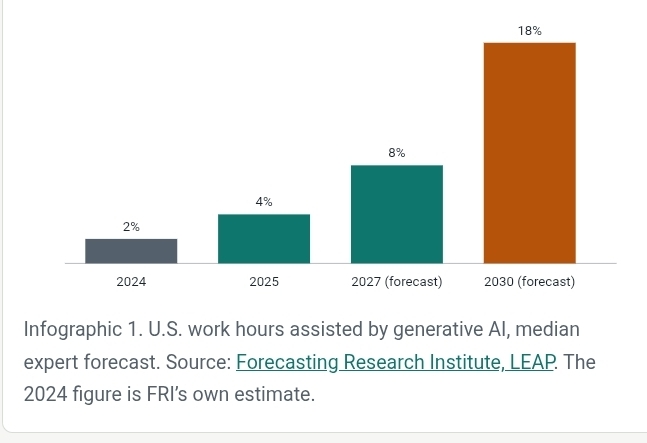
Short answer: AI is moving from standalone chatbots to agentic systems that plan, use tools and act with limited supervision, while physical AI and inference demand grow. The strongest sourced forecasts point to rapid adoption (about 18% of U.S. work hours AI-assisted by 2030) alongside rising electricity, jobs and governance pressures. Experts and lab leaders disagree sharply on when AGI arrives.
In this article:
- What is changing between 2026 and 2030?
- How fast will AI adoption grow?
- How big is the economic impact?
- What happens to jobs and skills?
- When will AGI arrive?
- What are the main risks?
- FAQ
- Sources
What is changing between 2026 and 2030?
The main shift is from ever-larger foundation models toward agentic AI (systems that plan, call tools and complete multi-step tasks) and physical AI (robotics, autonomous systems, wearables). Industry attention is moving from breakthrough demos to reliable value at scale: agent orchestration, cheaper inference and AI embedded in everyday tools such as search.
The State of AI Report 2026, published on 8 October 2026 as the ninth annual edition, describes a three-lab frontier race among Anthropic, OpenAI and Google. Secondary coverage of the report highlights a feedback loop in which agents assist AI research, drive recurring inference demand and attract more infrastructure spending.
Reported data points from that coverage include Claude handling 26% of measurable model R&D work at Anthropic in August 2026, up from under 1% in February, and four U.S. hyperscalers guiding to roughly $733 billion of 2026 capital spending. These are secondhand summaries; check the original report slides before reusing them.
How fast will AI adoption grow?
The Longitudinal Expert AI Panel (LEAP), run by the Forecasting Research Institute with 339 experts, gives the clearest quantified adoption path. Its median expert expects generative AI to assist 4% of U.S. work hours in 2025, 8% in 2027 and 18% in 2030.

The same panel’s median forecast is that AI training and deployment will use about 7% of U.S. electricity in 2030 and about 12% in 2040. By 2040 the typical expert expects AI’s impact to be comparable to a “technology of the century,” like electricity or the automobile.
How big is the economic impact?
McKinsey Global Institute estimated that generative AI could add the equivalent of $2.6 trillion to $4.4 trillion annually across 63 use cases, and that current technologies could automate activities absorbing 60 to 70 percent of employees’ time. Customer operations, marketing and sales, software engineering and R&D account for much of that value. This is a 2023 estimate, so treat it as a baseline rather than a 2026 measurement.
Other market-size figures often quoted (such as a global AI market near $4 trillion by 2035, or physical AI reaching $3.26 trillion by 2040) came from the source text for this article and could not be confirmed against primary reports here, so they are left out of the main analysis.
What happens to jobs and skills?
The World Economic Forum’s Future of Jobs Report 2025 projects 170 million new jobs and 92 million displaced by 2030, a net gain of 78 million and churn equal to 22% of today’s formal jobs. Nearly 40% of the skills needed in jobs are expected to change, and skills gaps are the top barrier to business transformation. These projections reflect technology, demographics, the green transition and geoeconomics together, not AI alone.

When will AGI arrive?
Definitions vary: human-level performance across most cognitive tasks, or systems that do most economically valuable work better and more cheaply than people. Timelines vary with them. LEAP reports that lab leaders predict human-level or superhuman AI between 2026 and 2029, while its expert panel’s median expects significantly less progress and longer timelines for superhuman capability.
Two camps on AI progress
| Group | Stated horizon | Basis |
| Frontier-lab leaders | Human-level or superhuman AI around 2026–2029 | Public statements, summarised by LEAP |
| LEAP expert panel (median) | Slower progress; longer timelines for superhuman AI Specific | Monthly falsifiable forecasts from 339 experts |
Specific year estimates attributed to individual executives and a 2050 panel median appeared in the source text but were not confirmed in the sources checked, so they are not repeated here. Either way, rising capability and investment make large effects likely regardless of the label.
What are the main risks?
- Labor disruption: churn is large even where net job counts rise, and reskilling lags.
- Energy and local resistance: coverage of the State of AI Report cites a March 2026 Gallup finding that 71% of Americans oppose a local AI data center.
- Security and governance: the report author highlights AI security failures that breached real systems, and governance still trails capability.
Practical takeaway: treat AI as infrastructure to integrate carefully. Value will depend less on any single model release than on evaluation, multi-agent orchestration, energy and chip supply, workforce reskilling and governance that keeps pace.
Frequently asked questions
What will AI look like by 2030?
Capable, specialised and increasingly agentic systems. The LEAP median is 18% of U.S. work hours AI-assisted by 2030.
When will AGI arrive?
Unknown. Lab leaders point to 2026–2029; the broader expert panel expects longer.
Will AI create or destroy jobs?
The WEF projects a net gain of 78 million jobs by 2030 across all trends, with about 40% of skills changing.
How much electricity will AI use?
LEAP’s median: about 7% of U.S. electricity in 2030 and 12% in 2040.
Sources
- Forecasting Research Institute, Introducing LEAP: The Longitudinal Expert AI Panel; work-hours figures also at Manifold’s LEAP question page.
- Air Street Capital, State of AI Report (2026 edition, 8 October 2026), and its site summary.
- Secondary coverage of the 2026 report: ToolNavs (German) and Remio (French). Verify against the original slides.
- McKinsey Global Institute, The economic potential of generative AI: The next productivity frontier (2023).
- World Economic Forum, Future of Jobs Report 2025 press release (January 2025).
- The Future of AI to 2030: Agents, Economics and the AGI Timeline Debate
- Why 1984 Is the Worst Dystopian World to Live In: 5 Nightmarish Alternatives Compared
- My Blogging Journey: Apparently, I’m Not Done Dreaming Yet!
- AI-generated deepfakes targeting women in politics intensify calls for stronger protection
- using AI in my daily routine is something I never thought I would …


Share your views on it