

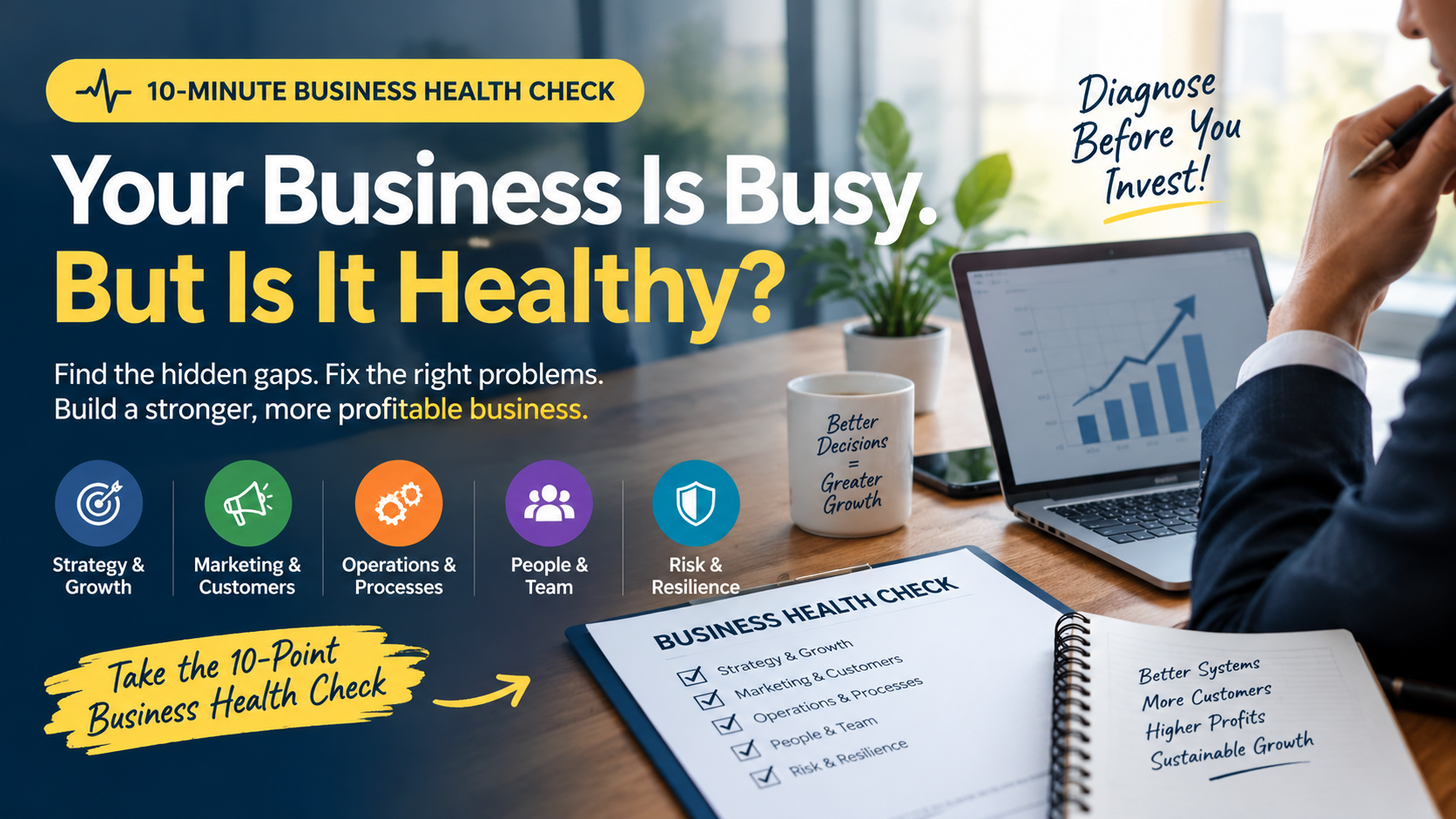
Business consultant reviewing a small business performance report

A practical business health check for SMEs, startups and growing businesses
Running a business takes time, effort and difficult decisions. But a full calendar, regular customer enquiries and a hardworking team do not automatically mean a business is healthy.
A business can generate sales while struggling with cash flow. It can attract social media engagement without converting prospects into customers. It can employ capable people while depending on the owner to approve every decision.
These are not always sales problems. Sometimes, they are signs of deeper issues in strategy, operations, marketing, financial management or leadership.
The solution is not necessarily to spend more, hire more people or work longer hours. It is to understand what is happening before deciding what to change.
This guide introduces a practical 10-minute business health check to help business owners identify potential weaknesses and decide where to investigate first.
Table of Contents
What Is a Business Health Check?
A business health check is a structured review of the areas that influence an organisation’s performance, sustainability and ability to grow.
Depending on the business, it may examine strategy, sales, marketing, cash flow, operations, people, customer experience, technology and risk management.
The purpose is not to judge a business by one metric. It is to identify gaps, understand their potential causes and establish priorities for improvement.
A short self-assessment is a starting point—not a substitute for a financial review, operational audit or professional advice where these are needed.
Why a Busy Business May Not Be a Healthy Business
Consider a small company receiving regular enquiries but converting very few into paying customers. The owner might conclude that the business needs more advertising.
However, the actual problem could be unclear pricing, slow responses, a poorly defined offer or a lack of trust.
Similarly, a business experiencing missed deadlines might blame employees when the underlying issue is an unclear workflow, inadequate training or conflicting priorities.
The principle is simple: identify the cause before investing in a solution.
Here are ten areas worth reviewing.
The 10-Minute Business Health Check
For each statement, select the response that best describes your business today.
Score 2 points for “Yes”, 1 point for “Partly” and 0 points for “No”.
1. Business Strategy and Direction
Can you clearly explain your target customers, your value proposition and your main business priorities for the next 90 days?
A business without clear priorities may spread its resources across too many activities without knowing which ones matter most.
Action: Write down your primary customer segment, the problem you solve, your key differentiator and three measurable business priorities.
2. Sales and Customer Acquisition
Do you know where your best customers come from and how prospects move from initial interest to a completed sale?
Without this information, it is difficult to determine whether growth depends on referrals, advertising, partnerships, repeat customers or another channel.
Action: Track enquiries, qualified leads, proposals, conversions and the sources of your customers.
3. Marketing Effectiveness
Can you connect your marketing activities to meaningful business outcomes rather than measuring success only through impressions, likes or follower counts?
Engagement can be useful, but it should be interpreted alongside enquiries, conversions, customer acquisition costs and retention where relevant.
Action: Choose a small set of metrics linked to your marketing objectives and review them regularly.
4. Financial Visibility
Do you review cash flow, upcoming financial commitments, outstanding payments and the profitability of your products or services?
Revenue and profit are not the same as available cash. A business can record sales while struggling to meet payments on time.
Action: Maintain a regular cash-flow forecast, monitor receivables and review costs with appropriate financial support.
5. Operations and Processes
Are your essential business activities documented clearly enough that work can be completed consistently without relying on one person’s memory?
Undocumented processes can lead to duplicated effort, delays, inconsistent service and avoidable errors.
Action: Identify the three processes that cause the most confusion and document the steps, responsibilities and expected outcomes.
6. Roles and Accountability
Do team members understand their responsibilities, decision-making authority, deadlines and performance expectations?
When accountability is unclear, tasks can be overlooked or repeatedly escalated to the owner.
Action: Clarify ownership of key tasks and define how completion and quality will be measured.
7. Customer Experience and Retention
Do you collect feedback, address complaints systematically and understand why customers return—or choose not to return?
Customer retention can provide important insight into service quality, product fit and long-term value.
Action: Review complaints, repeat purchases, customer feedback and recurring service issues.
8. Digital Presence and Trust
Can a potential customer quickly understand what you offer, whom you serve, why your business is credible and how to contact you?
An inconsistent online presence or unclear service information can introduce unnecessary friction into the buying process.
Action: Review your website, business profiles, contact details, service descriptions, testimonials where genuine, and enquiry process.
9. People, Skills and Communication
Do your employees or collaborators have the information, skills and support needed to perform their work effectively?
Not every performance issue is caused by a lack of effort. Expectations, tools, training and management practices can also influence outcomes.
Action: Identify recurring performance gaps and determine whether the appropriate response is training, clearer instructions, better tools or a process change.
10. Risk and Business Continuity
Could your business continue operating if a key employee became unavailable, a major customer left or an important digital system stopped working?
Every business faces risks. The objective is to identify significant exposures before they become disruptive.
Action: List your three most important operational risks and define a practical response for each.
How to Interpret Your Business Health Check Results
Add your scores for all ten questions. The maximum is 20 points.
- 16–20: A useful foundation to build on. Identify the weaker areas and verify that your processes and performance data support your assessment.
- 10–15: Improvement opportunities may be affecting performance. Prioritise the gaps most closely connected to your current business objectives.
- 0–9: Start with diagnosis and prioritisation. Review the basics before committing additional resources to expansion or marketing.
These score bands are an illustrative self-assessment framework, not a validated industry benchmark or a prediction of business success. A low score does not automatically mean a business is failing, and a high score does not guarantee financial health.
One critical weakness—such as cash-flow pressure, a serious compliance concern or a major customer dependency—may deserve immediate attention regardless of the total score.
What Should You Do After Identifying a Business Gap?
Avoid trying to fix all ten areas at once. Use a simple three-step process.
Step 1: Identify the most important problem.
Choose the gap that presents the greatest risk or is most directly connected to your business objective.
Step 2: Investigate the root cause.
Gather relevant evidence. Review data, speak with the people involved, examine the workflow and distinguish the visible symptom from the underlying issue.
Step 3: Define a measurable action.
Assign responsibility, establish a deadline and select an appropriate indicator of progress.
For example, if customer enquiries are not converting, you might examine response times, qualification questions, pricing clarity and follow-up consistency before increasing advertising expenditure.
The right solution depends on the evidence—not on a one-size-fits-all formula.
When Should You Consider a Business Consultant?
External support can be useful when a business problem persists, internal teams lack the time or expertise to investigate it, or the owner needs an independent perspective.
Depending on the issue, a business consultant may help with:
- Business strategy and prioritisation.
- Marketing positioning and customer acquisition.
- Process mapping and standard operating procedures.
- Organisational communication and training needs.
- Performance measurement and improvement planning.
A responsible consultant should clarify the scope of work, explain the proposed method, identify relevant limitations and agree on practical deliverables. They should not promise guaranteed growth or results without evidence.
The objective is to help a business make better decisions and implement appropriate improvements—not to sell a predetermined solution regardless of the problem.
Frequently Asked Questions
What is the purpose of a business health check?
It helps business owners review important areas of performance, identify possible weaknesses and decide which issues require further investigation.
How often should a business conduct a health check?
A brief review can be conducted monthly or quarterly, depending on the business. More detailed reviews may be appropriate when entering a new market, experiencing declining performance or planning significant investment.
Can a small business conduct its own business health check?
Yes. Owners can begin with a structured checklist and available business data. Specialist support may be necessary for complex financial, legal, regulatory or operational issues.
What is the difference between a business health check and a business audit?
A health check is often a preliminary, broad assessment. A formal audit or specialist review usually has a defined scope, methodology and evidence requirements. The terms should not be treated as interchangeable in every professional context.
Does a low score mean I need a consultant?
Not necessarily. It indicates areas worth examining. Some gaps can be addressed internally; others may benefit from external expertise. The decision should depend on the severity of the issue, available resources and the value of professional support.
Final Thoughts: Diagnose Before You Invest
Sustainable business improvement begins with an honest understanding of where your organisation stands.
Before investing more money in advertising, hiring additional staff or launching another initiative, take a few minutes to review your strategy, sales, marketing, finances, operations, people and risks.
You do not need to fix everything at once. You need to identify the right problem, understand its causes and choose a sensible next step.
Want a more structured review of your business?
I provide business consulting support across strategy, marketing, operational improvement and organisational effectiveness. If you are a business owner who has identified a persistent challenge, you can get in touch to discuss the problem, your objectives and whether a focused business review would be useful.
Note: This self-assessment is an educational starting point and is not a substitute for a professional financial, legal, compliance or specialist audit.


Share your views on it