

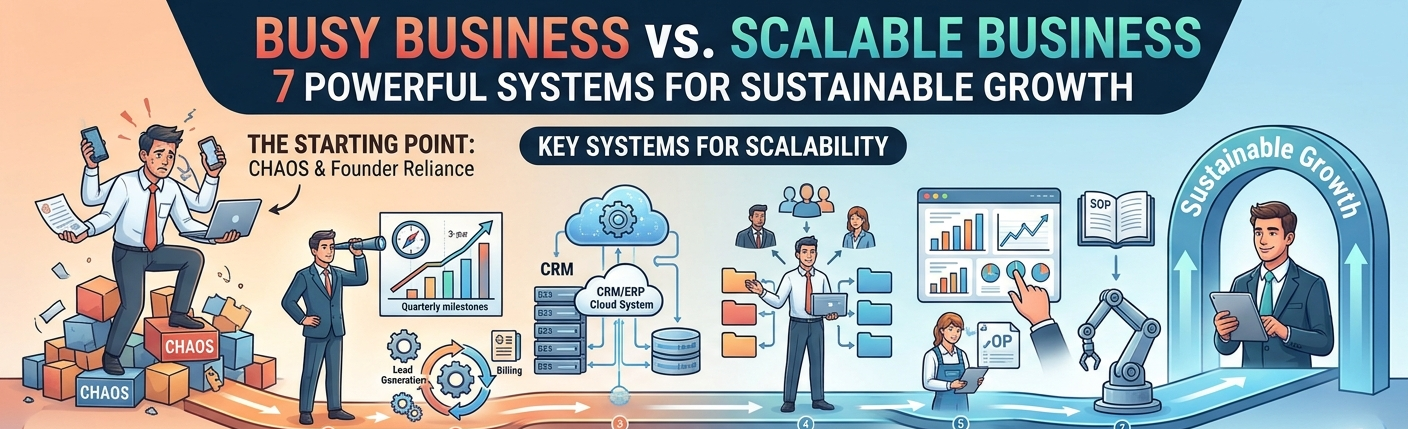
Busy Business vs. Scalable Business
Busy vs. Scalable Business: Are you building a business that can grow or one that needs you to work harder every day?
Many business owners start by doing everything themselves. They manage customers, approve decisions, solve problems, supervise employees and keep daily operations moving.
In the early stages, this approach can be practical. As a business grows, however, the same habits can become bottlenecks.
More customers mean more enquiries. More employees mean more coordination. More orders mean more processes to manage. Without the right systems, growth can increase complexity, pressure and operational risk.
The goal is not simply to build a busier business. It is to build a business that can deliver consistent results without depending on the owner for every routine decision.
In this guide, we explore the difference between a busy business and a scalable business, seven systems that support sustainable growth, and practical steps you can take to begin improving your organisation.
Table of Contents

What Is the Difference Between a Busy Business and a Scalable Business?
A busy business may depend heavily on individual effort, informal communication and the owner’s constant involvement to deliver results.
A scalable business has repeatable processes, clear responsibilities, suitable technology and performance measures that help it handle increasing demand without a proportional increase in confusion or avoidable work.
Scalability does not mean a business can grow without additional staff, investment or management. It means that growth is supported by systems designed to handle greater complexity.
For example, consider a service business that receives 20 customer enquiries a day. If every enquiry requires the owner to respond, qualify the customer, prepare a quotation and follow up, the owner may quickly become a bottleneck.
A documented enquiry process, clear qualification criteria, standard quotation templates and an agreed follow-up workflow could allow trained team members to handle routine work consistently.
The objective is not to remove the owner from the business entirely. It is to use the owner’s time where it adds the greatest value.
Seven Warning Signs That Your Business Depends Too Heavily on You

1. Every Decision Comes Back to the Owner
If employees need approval for routine matters, work can slow down even when the owner is available and experienced.
The underlying issue may be unclear decision-making authority, inadequate training or a lack of documented guidelines.
What to examine: Which decisions genuinely require your involvement, and which could be handled using agreed rules?
2. The Same Problems Keep Returning
Repeated mistakes often indicate that the underlying process has not been corrected.
For example, recurring customer complaints may be connected to unclear handovers, inconsistent quality checks or incomplete instructions.
What to examine: Are you resolving the cause of recurring problems or simply dealing with each incident separately?
3. Important Knowledge Exists Only in People’s Heads
When key procedures are undocumented, staff absences, resignations or rapid growth can disrupt operations.
What to examine: Could another trained person complete an essential task using clear instructions and access to the required information?
4. Growth Creates More Confusion
An increase in customers or orders should create opportunities, but it can also expose weaknesses in scheduling, inventory, communication, quality control or customer support.
What to examine: Which parts of the current workflow become unreliable when demand increases?
5. Employees Are Busy but Accountability Is Unclear
People can work hard without being clear about ownership, deadlines, decision rights or expected outcomes.
What to examine: Does every important task have a clear owner, a deadline and an agreed definition of completion?
6. You Cannot Easily Measure Performance
Without reliable information, managers may rely on assumptions to make decisions about staffing, marketing, customer service or investment.
What to examine: Which few indicators would tell you whether the business is improving?
7. The Business Struggles When You Step Away
If routine operations slow down whenever the owner is unavailable, the organisation may rely too heavily on personal intervention.
What to examine: Which responsibilities, approvals or relationships lack a backup process or capable alternative owner?
These signs do not automatically mean a business is failing. They are prompts for investigation and prioritisation.
Seven Systems That Help a Business Scale

1. A Clear Strategy and Set of Priorities
A business needs a shared understanding of its target customers, value proposition, objectives and immediate priorities.
Without this clarity, teams may pursue too many initiatives at once.
Start here: Identify three measurable priorities for the next 90 days and communicate how each contributes to the wider business objective.
2. Standard Operating Procedures (SOPs)
SOPs document how important tasks should be completed. They help preserve organisational knowledge, improve consistency and make training easier.
You do not need to document every activity immediately.
Start here: Choose one recurring process that causes delays, confusion or errors. Record its purpose, steps, responsible role, required inputs and expected output.
3. Defined Roles and Decision Rights
Employees need to know what they own, which decisions they can make and when escalation is necessary.
Start here: Create a simple responsibility matrix for a recurring workflow. Identify the person responsible for completing the task, the person accountable for the result and anyone who must be consulted or informed.
4. A Repeatable Sales and Customer Management Process
Customer acquisition should not depend entirely on memory or inconsistent follow-up.
Start here: Map the customer journey from first enquiry to qualification, proposal, sale, delivery and follow-up. Identify where leads are lost or customers experience delays.
5. A Small Set of Meaningful Performance Indicators
Metrics help a business understand whether its systems are delivering the intended results.
Depending on the organisation, useful measures may include enquiry response time, conversion rate, turnaround time, error frequency, customer retention or overdue tasks.
Start here: Choose a small number of indicators linked to current priorities. Define how each is measured, who reviews it and how frequently.
6. A Reliable Communication and Review Rhythm
Processes need to be supported by clear communication and regular reviews.
Start here: Introduce a brief weekly operational review focused on priorities, blockers, overdue actions, risks and decisions. Keep it structured and action-oriented.
7. Documented Risk and Business Continuity Plans
A business should understand what happens if a key employee, important supplier, major customer or essential digital system becomes unavailable.
Start here: Identify three significant operational risks, estimate their potential impact and decide what practical backup arrangements are needed.
How to Start Building a More Scalable Business
Trying to introduce every system at once can create unnecessary work. A better approach is to identify the most important bottleneck and improve it systematically.
Step 1: Select one recurring problem.
Choose an issue that consumes significant time, causes repeated errors or directly affects customer experience.
Step 2: Map the current process.
Write down the actual steps, decisions, handovers and delays. Involve the people who perform the work.
Step 3: Identify the root cause.
Determine whether the problem relates to unclear responsibilities, missing information, unnecessary approvals, inadequate tools, training or process design.
Step 4: Design a practical improvement.
Create or update the relevant procedure, clarify ownership and introduce the simplest useful control.
Step 5: Measure the result.
Record a baseline before making the change. Then compare results after implementation, taking account of other factors that may affect performance.
For example, if quotations are consistently delayed, measure the current turnaround time, map the approval process and identify unnecessary handovers. After introducing a clearer workflow, review whether turnaround time and error rates improve.
The purpose is to learn what works in your actual business—not to adopt a fashionable management framework without understanding the problem.
A Practical Business Systems Self-Check
Answer each question with Yes, Partly or No.
- Are our main business priorities clear?
- Are our critical processes documented?
- Do employees understand their responsibilities and decision-making authority?
- Is there a consistent process for handling customer enquiries?
- Do we review a small set of meaningful performance indicators?
- Are recurring operational problems investigated at their root cause?
- Can essential tasks continue when a key person is unavailable?
If you answer No or Partly to several questions, identify which gap creates the greatest operational risk or prevents progress towards your current objectives.
This checklist is a preliminary reflection tool, not a formal audit or validated performance benchmark.
When Should You Seek Business Consulting Support?
Business consulting may be useful when operational bottlenecks persist, growth has increased complexity, teams struggle with accountability or internal resources are insufficient to investigate a problem objectively.
Depending on the business need, a consultant may help with:
- Business strategy and prioritisation.
- Process mapping and SOP development.
- Marketing and customer acquisition workflows.
- Roles, accountability and performance measures.
- Organisational communication and training needs.
- Business improvement planning and implementation support.
A useful consulting engagement should have a clear scope, agreed deliverables, a practical implementation plan and suitable ways to assess progress.
The right recommendation depends on the business context. Not every organisation needs a complex software system, a large restructuring project or a lengthy strategy document. Sometimes, a clearly defined process and better accountability are the appropriate starting point.
Frequently Asked Questions
What is the difference between a busy business and a scalable business?
A busy business may depend heavily on individual effort and informal processes. A scalable business uses repeatable workflows, clear responsibilities and performance measures to manage greater demand more consistently.
How can a small business become more scalable?
Start by identifying recurring bottlenecks, documenting critical processes, clarifying responsibilities, measuring performance and improving one high-impact workflow at a time.
Do small businesses need standard operating procedures?
SOPs can be useful when tasks are repeated, quality needs to remain consistent, training is required or mistakes are costly. The level of documentation should match the complexity and risk of the process.
No. Scalability can involve better processes, training, delegation, technology and improved decision-making. Automation is only one possible tool and should be introduced when it addresses a real need.
When should a business hire a consultant?
Consider external support when a persistent problem requires specialist expertise, an independent assessment or implementation capacity that the organisation does not currently have.
Final Thoughts: Build Systems That Support Growth
A business should not have to rely on constant urgency to function effectively.
When strategy is clear, processes are documented, responsibilities are understood and performance is measured, owners and teams have a stronger foundation for making decisions and responding to growth.
You do not need to transform the entire organisation in one week. Start with one recurring problem, investigate its cause and improve the process in a measurable way.
Want to identify the bottleneck holding your business back?
I provide business consulting support across strategy, marketing, operational improvement and organisational effectiveness. If your business is struggling with recurring delays, owner dependency, unclear processes or difficulties managing growth, get in touch through my professional profile or business website to discuss your priorities.
Request a conversation about a focused Business Systems Review and identify the areas where practical improvements may make the greatest difference.
This article provides general educational information. Recommendations should be adapted to the organisation’s circumstances, resources, regulatory obligations and risk profile.


Share your views on it