
What’s a song that changed your life?
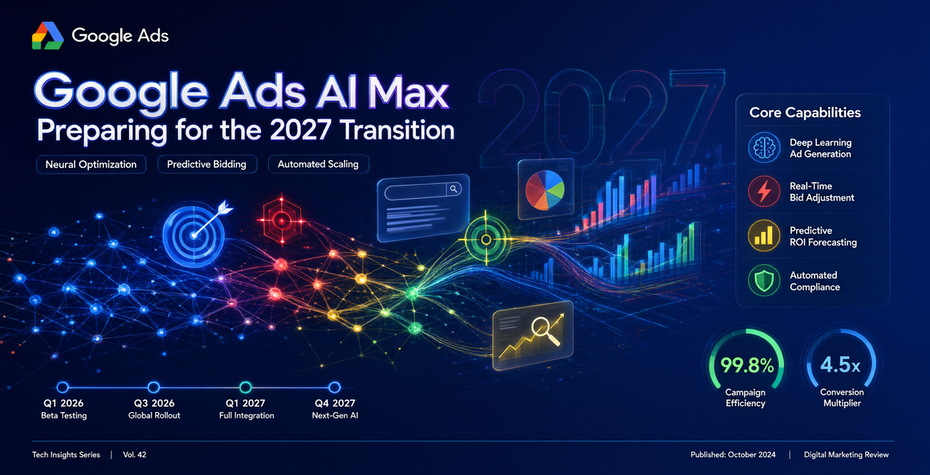
Google Ads is moving towards AI-powered Search campaigns, and digital marketers need to prepare now. Google’s AI Max is changing how advertisers discover search queries, generate ad copy, match landing pages and optimise paid search campaigns. With the automatic migration of Dynamic Search Ads (DSA) scheduled to begin in February 2027, advertisers should review their existing campaigns before the transition takes place.

The change represents more than a technical upgrade. It reflects a broader transformation in digital advertising: moving from predominantly keyword-driven campaign management towards AI-assisted targeting, creative optimisation and real-time search intent matching.
For businesses, agencies, freelancers and PPC specialists, understanding Google Ads AI Max is becoming an important part of maintaining effective advertising strategies.
This guide explains what AI Max is, why Google is introducing it, which campaign features are changing, what advertisers should expect in 2027, and seven practical steps to prepare.
Table of Contents
1. What Is Google Ads AI Max?
Google Ads AI Max is a suite of AI-powered targeting and creative optimisation features designed to improve the reach and performance of Search campaigns.
Rather than relying exclusively on manually selected keywords, AI Max uses a combination of advertiser-provided information, website content, search context and other signals to identify relevant search opportunities.
It helps advertisers connect with potential customers whose searches may not match their original keyword lists exactly.
AI Max combines three principal capabilities:
- Search term matching: Helps identify relevant searches beyond traditional keyword matching.
- Text customization: Uses AI to generate or adapt advertising text based on the user’s search intent and relevant website content.
- Final URL expansion: Helps direct users to relevant landing pages on an advertiser’s website rather than always sending everyone to one predetermined destination.
Google officially moved AI Max for Search campaigns out of beta in April 2026 and has continued introducing additional controls and capabilities.
According to Google, advertisers using the full AI Max feature suite experienced an average of 7% more conversions or conversion value at a similar cost per acquisition (CPA) or return on ad spend (ROAS), compared with using search term matching alone.
Important: This is a Google-reported internal performance figure for non-retail advertisers, not a guaranteed improvement for every campaign. Actual results depend on the account, industry, budget, conversion tracking and implementation.
Source: Google, AI Max for Search Campaigns.
2. Why Is Google Moving Towards AI Max?
The way people search online is changing.
Previously, advertisers could build campaigns around relatively predictable keyword combinations. Someone looking for a marketing consultant, for example, might search for:
- Digital marketing consultant
- SEO services
- PPC advertising agency
- Social media marketing services
However, modern searches are becoming more conversational, descriptive and context-specific.
A potential customer might now search:
“Which digital marketing agency can help my small business generate qualified international leads without spending too much?”
This search communicates several things:
- The person owns or manages a small business.
- They need digital marketing services.
- Their objective is lead generation.
- They have a budget constraint.
- They are interested in a practical business outcome.
Traditional keyword planning can struggle to account for every variation of such searches.
AI-powered advertising aims to understand these broader patterns and identify opportunities that advertisers may not have anticipated when building their campaigns.
Four reasons behind the transition
1. More complex search behaviour
Consumers increasingly use longer, conversational and highly specific search queries.
2. Greater reliance on automation
Advertisers want systems that can identify relevant audiences, optimise creative content and allocate advertising resources more efficiently.
3. Better use of website content
AI Max can use website information to help match searches with relevant advertising messages and landing pages.
4. More integrated campaign management
Google is bringing targeting, creative optimisation and landing-page selection into a more unified Search campaign framework.
The objective is to make advertising more responsive to customer intent while giving advertisers additional controls over how automation operates.
3. What Are the Main Features of AI Max?
Understanding the three main features is essential before changing an existing campaign.
A. Search Term Matching
Search term matching helps advertisers reach relevant search queries beyond their original keyword selections.
For example, a business targeting:
“Corporate training services”
might also reach people searching for:
- Professional workplace communication training
- Employee development programmes
- Corporate leadership workshops
- Business communication skills training
This can increase reach and help advertisers discover new customer segments.
However, broader matching does not automatically mean better targeting.
Advertisers must monitor search-term reports, exclude irrelevant queries and ensure that their campaigns remain aligned with their business objectives.
B. Text Customization
Text customization uses Google’s AI capabilities to generate or adapt advertising text according to search intent and relevant website content.
For example, an advertiser offering SEO services might have a standard headline:
“Professional SEO Services for Businesses”
AI-generated variations could emphasise more specific benefits, such as:
- Improve Your Website’s Search Visibility
- SEO Strategies for Growing Businesses
- Attract More Relevant Organic Traffic
These are illustrative examples, not guaranteed Google-generated headlines.
Advertisers should review generated content carefully to ensure that it is accurate, compliant and consistent with their brand.
This is particularly important for regulated industries, financial services, healthcare and businesses making specific performance claims.
C. Final URL Expansion
Final URL expansion allows Google to select a relevant landing page from an advertiser’s website based on the user’s search.
For example, someone searching for SEO services might be directed to an SEO service page, while someone searching for business consulting could be directed to a business consultancy page.
This can improve relevance by reducing the need to send every visitor to the homepage.
However, it introduces an important responsibility: ensuring that the website contains appropriate, accurate and conversion-focused landing pages.
Advertisers should review URL exclusions and monitor which pages Google selects.
Sending paid traffic to irrelevant blog articles, outdated pages or incomplete service descriptions can waste advertising expenditure.
4. Google Ads Migration Timeline: What Changes in 2026 and 2027?
One of the most important things advertisers should understand is that Google is implementing this transition in phases.
Not every legacy Search campaign is being migrated at the same time.
Google’s August 2026 developer announcement clarified the following schedule.
| Date | Development | What advertisers need to know |
|---|---|---|
| April 2026 | AI Max moves out of beta | The feature suite becomes a more established Search campaign offering. |
| 3 August 2026 | Creation of certain legacy configurations ends | New campaign-level broad match and legacy automatically created asset configurations are blocked. |
| 1–30 September 2026 | Phase 1 automatic migration | Eligible campaigns using campaign-level broad match and standalone automatically created assets are upgraded. |
| 12 August 2026 announcement | DSA migration rescheduled | Google confirms that the DSA transition will take place in February 2027. |
| 15 January 2027 | DSA reminder notification | Google plans to remind affected advertisers about the upcoming migration. |
| 1–28 February 2027 | Phase 2 automatic migration | Remaining eligible Dynamic Search Ads campaigns will be upgraded to standard Search ad groups with AI Max enabled. |
What has already happened?
As of November 2026, the September migration phase for eligible campaign-level broad match and automatically created asset configurations has already taken place.
Dynamic Search Ads campaigns, however, are scheduled for a separate migration beginning in February 2027.
This distinction is important. Advertisers should not assume that all existing campaigns have already been migrated or that all Search campaigns will automatically change.
Google also states that eligible DSA campaigns will retain relevant historical settings and data through the migration process, with AI Max settings configured to mirror their previous setup as closely as possible.
For the detailed migration schedule, consult Google’s official Google Ads Developer Blog announcement.
5. AI Max vs Traditional Search Campaigns
How does AI Max differ from conventional keyword-focused Search advertising?
| Feature | Traditional Search approach | AI Max approach |
|---|---|---|
| Targeting | Primarily keyword-led | AI-assisted search term matching |
| Search discovery | Relies heavily on planned keywords and match types | Can identify additional relevant queries |
| Ad copy | Primarily advertiser-written | Can include AI-generated text variations |
| Landing pages | Advertiser selects predetermined URLs | Final URL expansion can select relevant pages |
| Optimisation | More manual campaign management | Greater use of automated optimisation |
| Control | Direct management of keywords, ads and URLs | Additional AI controls, exclusions and reporting |
| Monitoring | Search terms, keywords and conversions | Search terms, generated assets, landing pages and conversions |
AI Max does not mean that traditional Search advertising disappears.
Advertisers can continue using standard Search campaign structures and keyword-based approaches. AI Max adds capabilities that help extend targeting and creative optimisation.
The important change is that advertisers need to manage not only the keywords they select but also the additional search opportunities and creative decisions made by automation.
6. Seven Smart Ways to Prepare for the AI Max Transition
The February 2027 Dynamic Search Ads migration may seem distant, but preparation should begin well before the deadline.
Here are seven practical steps for advertisers and digital marketing professionals.
1. Audit Your Existing Google Ads Campaigns
Start by identifying which campaigns use:
- Dynamic Search Ads
- Campaign-level broad match settings
- Automatically created assets
- Standard keyword-based Search campaigns
- Existing AI Max features
Not every campaign will require the same changes.
Create an inventory of active campaigns, budgets, conversion goals, targeting settings and landing pages.
This will help you identify which campaigns have already been upgraded and which require attention.
2. Review Your Conversion Tracking
AI-powered optimisation depends heavily on conversion data.
If your tracking is inaccurate, automation may optimise towards the wrong outcome.
For example, a business might receive hundreds of website visits but very few qualified enquiries.
If its conversion setup counts every page visit as a successful conversion, the campaign could appear successful while generating little commercial value.
Review:
- Google Ads conversion actions
- Google Analytics 4 integration
- Form submission tracking
- Phone-call conversion tracking
- Purchase and lead values
- Duplicate conversion events
- Primary and secondary conversion settings
Focus on meaningful business outcomes rather than superficial engagement metrics.
3. Improve Your Website and Landing Pages
Final URL expansion makes website quality particularly important.
Google may select different pages according to the relevance of their content.
Make sure your website contains:
- Clear service descriptions
- Relevant landing pages
- Accurate pricing information where appropriate
- Strong calls to action
- Mobile-friendly layouts
- Fast-loading pages
- Trust indicators and contact information
A business offering SEO, social media management and corporate training should ideally have dedicated service pages rather than relying on a single generic homepage.
4. Strengthen Your Negative Keyword Strategy
Broader search discovery can expose campaigns to queries that are technically related but commercially irrelevant.
For example, a company selling professional digital marketing services may not want to pay for searches involving:
- Free digital marketing courses
- Digital marketing jobs
- Marketing internships
- Free advertising templates
- Digital marketing exam questions
Regularly examine search-term reports and add appropriate negative keywords.
The goal is not to restrict every new query. It is to prevent advertising expenditure on searches that do not support the campaign objective.
5. Review Brand Controls and URL Exclusions
AI Max offers additional controls that help advertisers guide automated targeting.
Use relevant brand inclusion and exclusion settings where appropriate.
Review URL exclusions to prevent traffic from being sent to unsuitable pages, such as:
- Careers pages
- Privacy-policy pages
- Outdated promotions
- Internal search-result pages
- Irrelevant informational articles
Do not exclude every non-service page automatically. Some educational content can be useful in customer acquisition, depending on the campaign’s objective.
6. Test AI-Generated Ad Copy Before Scaling
AI-generated headlines and descriptions should be treated as advertising drafts that require review.
Check every variation for:
- Factual accuracy
- Brand consistency
- Grammar and clarity
- Relevant customer benefits
- Legal and industry compliance
- Appropriate calls to action
Do not allow AI to introduce promises that your business cannot substantiate.
For example, statements such as “Guaranteed First Position on Google” or “100% Increase in Sales” should not be used without a legitimate and supportable basis.
7. Run Controlled Experiments and Monitor Performance
Avoid changing multiple campaign variables simultaneously.
Compare performance before and after enabling AI Max features.
Monitor:
- Impressions
- Click-through rate (CTR)
- Cost per click (CPC)
- Conversion rate
- Cost per acquisition (CPA)
- Return on ad spend (ROAS)
- Search-term relevance
- Landing-page performance
- Lead quality
Use Google Ads experiments where available to compare configurations.
Allow sufficient time and conversion volume before drawing conclusions.
The purpose is to determine whether AI Max improves actual business performance, not simply whether it generates more impressions or clicks.
7. Potential Benefits and Challenges of AI Max
AI Max offers meaningful opportunities, but advertisers should understand both sides.
Potential benefits
Greater search reach: Campaigns may discover relevant queries beyond manually selected keywords.
More relevant advertising: AI-generated text can help align messaging with individual search intent.
Better landing-page matching: Final URL expansion can connect visitors with more relevant website content.
Reduced repetitive management: Automation may reduce some manual campaign-maintenance tasks.
New optimisation opportunities: Search-term and performance insights can help advertisers understand customer behaviour.
Potential challenges
Reduced predictability: Broader matching may expose campaigns to searches that were not originally anticipated.
Budget inefficiency: Irrelevant queries can consume advertising budgets if exclusions and monitoring are weak.
Creative accuracy: AI-generated text may contain unsuitable claims or messaging.
Landing-page risks: Automated URL selection may direct users to pages that are not ideal for conversion.
Overdependence on automation: Advertisers who stop analysing campaign data may overlook performance problems.
The best approach is controlled automation: use AI to expand opportunities while retaining human oversight of strategy, budgets, brand communication and business objectives.
8. What Does AI Max Mean for Small Businesses and Digital Marketing Agencies?
The transition creates opportunities as well as challenges for marketing professionals.
Small businesses may benefit from AI-assisted advertising because they often have limited time and resources for extensive campaign management.
However, automation does not eliminate the need for sound marketing strategy.
A successful campaign still requires:
- A clearly defined target audience.
- A competitive and relevant offer.
- An appropriate advertising budget.
- Accurate conversion tracking.
- High-quality landing pages.
- A strong understanding of customer intent.
For digital marketing agencies and freelancers, this is an opportunity to move beyond basic keyword management.
Instead of simply offering Google Ads campaign setup, professionals can develop more comprehensive services.
Five potential services for digital marketing professionals
- Google Ads Migration Audit: Identify legacy campaign configurations and prepare accounts for AI Max.
- Conversion Tracking Audit: Review Google Ads and GA4 tracking to ensure optimisation uses meaningful outcomes.
- Landing Page Optimisation: Improve page relevance, usability and lead-generation potential.
- AI Search Campaign Management: Develop and monitor AI-assisted Search campaigns.
- Monthly PPC Performance Reporting: Explain campaign results in terms of leads, acquisition costs and business outcomes.
These services can be particularly valuable to SMEs that want to use AI without losing control over advertising expenditure.
For agencies, the competitive advantage will increasingly come from understanding customer behaviour, conversion economics and campaign strategy—not simply knowing where to click inside Google Ads.
9. Frequently Asked Questions About Google Ads AI Max
What is Google Ads AI Max?
Google Ads AI Max is a suite of AI-powered features for Search campaigns. It includes search term matching, text customization and final URL expansion to help advertisers discover relevant queries, adapt advertising messages and select suitable landing pages.
Is Google Ads AI Max replacing traditional Search campaigns?
No. AI Max enhances standard Search campaigns with additional targeting and creative capabilities. Traditional keyword-based advertising remains available.
When will Dynamic Search Ads migrate to AI Max?
Google has rescheduled the automatic migration of eligible Dynamic Search Ads campaigns to February 2027. The migration period is scheduled to run from 1 February to 28 February 2027.
Have all Google Ads campaigns already been upgraded?
No. The September 2026 migration covered eligible campaigns using campaign-level broad match settings and standalone automatically created assets. Dynamic Search Ads have a separate February 2027 migration schedule. Not every Search campaign is automatically affected.
Will AI Max increase advertising costs?
Not necessarily. AI Max does not guarantee lower CPCs or higher conversion rates. Actual costs depend on competition, bids, search relevance, campaign settings and conversion performance.
Advertisers should monitor CPA, ROAS and lead quality rather than assume automation will reduce expenditure.
Can advertisers control AI-generated advertising text?
Advertisers retain controls over their campaigns, including text guidelines and asset settings. However, they should review generated content, monitor performance and ensure that advertising claims comply with applicable policies.
Does AI Max work for small businesses?
Yes. Small businesses can use AI Max where it is available and suitable for their Search campaigns. However, successful implementation requires relevant landing pages, accurate conversion tracking, an appropriate budget and regular monitoring.
Should businesses upgrade to AI Max immediately?
Not necessarily. Businesses should first audit their campaigns, understand the feature changes, review their conversion tracking and determine which settings are appropriate. They should also check Google Ads account notifications and the latest migration guidance before making changes.
10. Final Thoughts: Prepare for AI-Powered Advertising, but Keep Strategy Human
Google Ads AI Max represents an important evolution in paid search advertising.
As search behaviour becomes more conversational and customer journeys become increasingly complex, advertisers need tools that can identify opportunities beyond traditional keyword lists.
However, automation should not replace marketing fundamentals.
Understanding customer needs, creating relevant offers, maintaining high-quality websites, tracking meaningful conversions and managing budgets responsibly remain essential.
The February 2027 Dynamic Search Ads migration provides a clear deadline for advertisers to review their existing campaign structures.
Businesses that prepare early can evaluate the new features, identify weaknesses in their websites and conversion tracking, and make informed decisions rather than reacting to automatic changes at the last minute.
The future of successful Google Ads management will not belong simply to those who use the most AI. It will belong to those who combine intelligent automation with sound marketing strategy, accurate data and a clear understanding of their customers.
At DMMS, we believe technology should support better business decisions. AI-powered advertising can create new opportunities, but sustainable growth still depends on relevance, trust, measurement and strategic execution.
- Google — AI Max for Search Campaigns
- Google — We’re Upgrading Dynamic Search Ads to AI Max
- Google Ads Developer Blog — August 2026: Migration of Campaign-Level Broad Match, Automatically Created Assets and Dynamic Search Ads
- Google Ads Help — About Dynamic Search Ads, Ad Rank and Performance
- Google Ads — Official AI Max Campaign Information
Last reviewed: 2 November 2026. Google Ads features, eligibility and migration schedules may change. Always consult the official Google Ads documentation and your account notifications before making campaign changes.


Share your views on it