

What was your first ever videogame?

Table of Contents
1. Introduction: A Job Opportunity That Raised Serious Concerns
Job seekers often spend months searching for stable employment. When a recruiter claims to represent a globally recognised airline such as Emirates, the opportunity can sound especially attractive.
Unfortunately, the reputation of a well-known company can also be exploited by people who falsely claim to represent it.
This article shares a concerning recruitment incident reported to me in Lahore, Pakistan, in October 2026. The incident involved a caller identifying himself as Kashif Butt, claiming to be a Human Resources manager at Emirates Airline at Lahore’s Allama Iqbal International Airport.
The caller reportedly discussed filling a Manager Administration position at the Lahore airport terminal. After a candidate’s CV was referred to him, the candidate reported receiving a telephone interview, pressure to attend an urgent meeting, and instructions to obtain attestation for several personal and educational documents before the position could be closed.
The reported cost was approximately Rs. 1,750 per document, with the total estimated at around Rs. 14,000. The candidate also reported that the conversation subsequently involved abusive language.
These details raise serious recruitment-fraud warning signs that deserve public attention.
Important clarification: This article documents a reported incident and potential warning signs. The caller’s identity, employment status, affiliation with Emirates, the legitimacy of the claimed attestation process, and any criminal intent have not been independently established here. The purpose is public awareness, not a definitive finding against a named individual or company.
2. What Happened? The Reported Emirates Hiring Scam in Lahore
The following account is based on my experience and the information provided to me by the referred candidate.
On or around 25–26 October 2026, I received a telephone call from someone who identified himself as Kashif Butt and claimed to be an HR manager at Emirates Airline, Lahore Airport.
He requested assistance in filling a Manager Administration position at the Lahore terminal of Allama Iqbal International Airport.
Believing that the request might concern a genuine employment opportunity, I forwarded a candidate’s CV for consideration.
Step 2: The candidate received a telephone interview
According to the candidate, the same caller subsequently contacted him and conducted an initial interview over the telephone.
The caller then instructed the candidate to meet a general manager before 4 p.m. that day.
The call reportedly took place at approximately 2 p.m., leaving the candidate with a short period in which to arrange transport, prepare documents and reach the airport.
Step 3: A demand for document attestation
The candidate reported being told that, before attending the meeting, he had to obtain attestation of his documents from an Aviation Department office in Johar Town, Lahore.
The documents reportedly included:
- The candidate’s CNIC.
- The spouse’s CNIC.
- Educational certificates and testimonials from matriculation onwards, up to the candidate’s current qualification.
- The candidate’s domicile certificate.
The candidate explained that he was in Lahore Cantt and would need considerable time to reach Johar Town and then travel to the airport. He asked whether he could attend the meeting that day and submit the attested documents the following day.
According to his account, the caller refused, saying that the position had to be closed that day and that the attested documents were mandatory.
Step 4: An estimated expense of Rs. 14,000
The candidate reported that the caller quoted an attestation charge of Rs. 1,750 per document.
Based on the candidate’s understanding of the number of documents required, he estimated that the total expense would be approximately Rs. 14,000.
At this stage, the demand raised an important question: Why was a candidate being pressured to arrange and potentially pay for multiple document attestations through a process that had not yet been independently verified?
Document verification can be a legitimate part of recruitment. However, applicants should never assume that an urgent payment demand is genuine simply because it is described as an official requirement.
The identity of the relevant office, the actual fee schedule, the required documents and the recipient of any payment should all be independently verified.
Step 5: The conversation reportedly became abusive
The candidate further reported that the caller began using abusive language during the interaction.
The candidate indicated that screenshots of the relevant chat could be shared as supporting material.
If authentic and appropriately redacted, such records may help establish the sequence of communications and support a request for investigation.
At the time of writing, the underlying chat, the caller’s official identity and the claimed employment process have not been independently authenticated for this article.
Why I am sharing this incident
I am sharing this account because job seekers deserve to know the warning signs associated with suspicious recruitment approaches.
A person may be searching for work to support a family, pay educational expenses or secure a more stable future. Losing money to a fraudulent recruitment scheme can create significant financial and emotional hardship.
Public awareness can help prevent other applicants from making rushed decisions or disclosing sensitive personal information to unverified individuals.
3. Seven Recruitment Red Flags Job Seekers Should Never Ignore
The reported incident highlights several warning signs worth remembering.
Red flag 1: A recruiter whose identity cannot be independently verified
A caller claiming to work for a reputable airline is not proof of employment or authority to recruit.
A professional-sounding title, knowledge of airport terminology or familiarity with recruitment processes can be imitated.
What to do: Contact the company through its independently located official website or verified recruitment channels. Do not rely exclusively on a phone number or contact details supplied by the caller.
Red flag 2: Pressure to attend a meeting immediately
The candidate reported being asked to meet a senior manager before 4 p.m., despite receiving the call around 2 p.m.
An urgent appointment is not proof of fraud by itself. However, urgency becomes concerning when an applicant is told that the opportunity will disappear unless they comply with an unverified financial or administrative demand.
What to do: Ask for the job reference, official interview invitation, venue details and written confirmation through a verifiable company channel.
Red flag 3: An unexplained demand for document attestation
Educational certificates and identity documents may be required during legitimate recruitment.
The concern here is the reported insistence on obtaining attestation through a specified office before an interview, without the process having been independently verified.
What to do: Contact the relevant authority directly to confirm whether it offers the stated service, whether the requested documents require attestation, what the official fees are, and whether the claimed recruitment procedure is genuine.
Never visit an unfamiliar office or hand over original documents solely on the instructions of an unverified caller.
Red flag 4: A demand for money before recruitment is verified
The reported Rs. 1,750-per-document charge is a key warning sign because the candidate understood that payment or expenditure was necessary to progress the application.
The critical question is not merely whether a document can legitimately be attested for a fee. It is whether the fee, recipient, procedure and claimed employment requirement are genuine.
What to do: Do not transfer money to a personal account, mobile wallet or unofficial intermediary. Verify the procedure directly with the relevant government authority and the employer.
Red flag 5: A claimed deadline to close the vacancy
The caller reportedly said that the position had to be closed that day.
Scammers often exploit a person’s fear of losing a valuable opportunity. A legitimate hiring process may have deadlines, but those deadlines should be verifiable and should not prevent reasonable checks of identity and payment requirements.
What to do: Never allow a recruiter to use urgency to prevent independent verification.
Red flag 6: Unprofessional or abusive communication
The candidate reported that the caller’s language became abusive.
Unprofessional conduct is not conclusive evidence of fraud, but abusive pressure is a serious reason to pause communication and seek verification.
What to do: Preserve the messages and call records. Avoid escalating the exchange, and report the conduct through appropriate channels if warranted.
Red flag 7: Requests for excessive personal information
The reported list included the spouse’s CNIC as well as the candidate’s identity and educational documents.
Some recruitment procedures may legitimately request family or identity information at a particular stage. However, an applicant should establish why each document is necessary, who will receive it and how it will be protected.
What to do: Share only the information necessary for a verified process. Never disclose passwords, banking credentials, one-time passwords or other authentication details.
4. Does Emirates Airline Charge Recruitment Fees?
This is one of the most important questions raised by the incident.
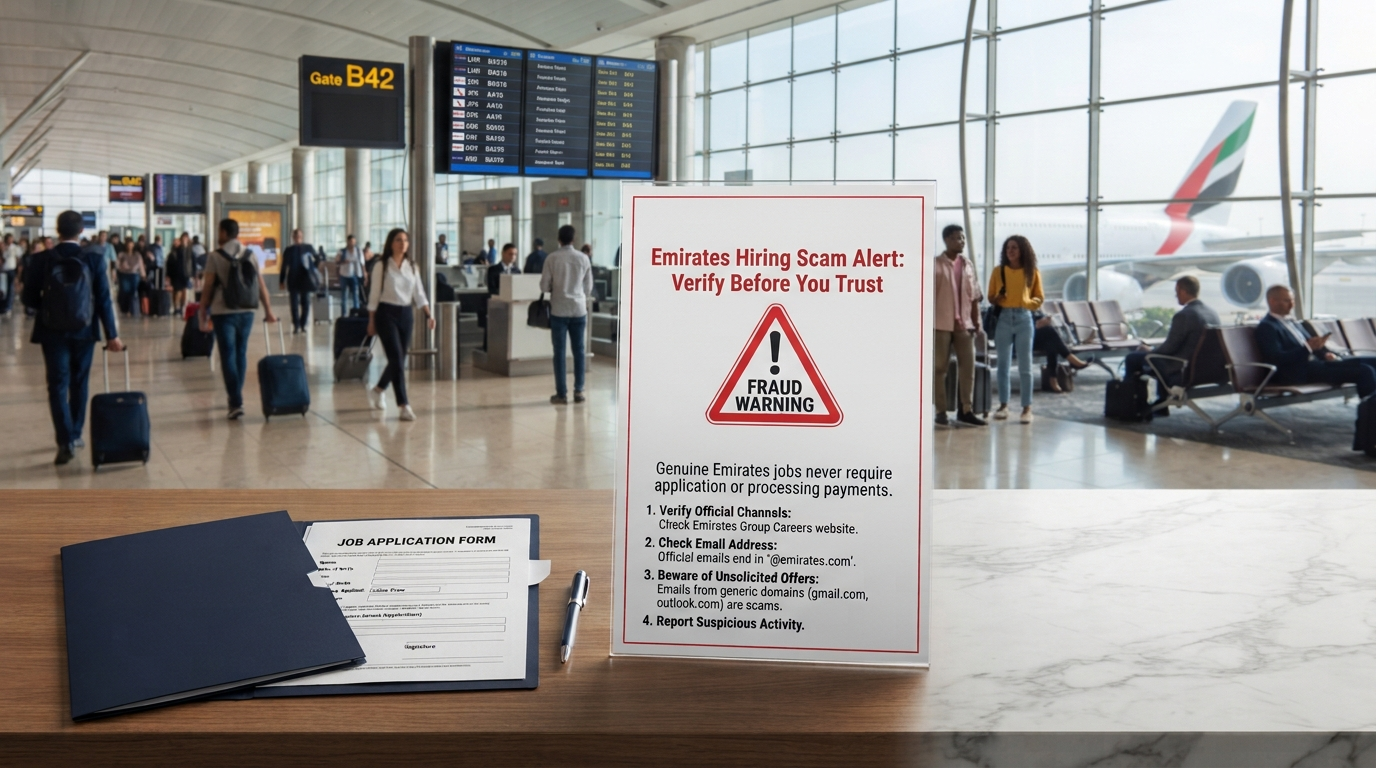
According to the official Emirates Group recruitment-fraud advisory, Emirates Group does not ask job applicants to pay recruitment fees or transfer money as part of the hiring process. It also warns that people may impersonate company personnel to obtain money or sensitive information.
The company advises applicants to verify opportunities through its official careers website and to be cautious of suspicious communications through social media, messaging apps and personal email accounts.
Official source: Emirates Group — Recruitment Fraud
This official guidance is particularly relevant when evaluating a claimed Emirates job opportunity.
However, it is important to distinguish a recruitment fee from a separate, independently verifiable fee charged by a legitimate public authority for a genuine document service. The reported incident does not establish that the claimed Aviation Department fee was authentic or that the caller was affiliated with Emirates.
The safest rule is simple: do not pay a person claiming to be a recruiter unless the process and any payment requirement have been independently verified through official channels.
If a recruiter says that paying money is mandatory to secure a position, stop and check the claim before proceeding.
5. How to Verify an Emirates Job Offer
Before responding to a recruitment approach, follow these steps.
Step 1: Visit the official careers website
Use the official Emirates Group careers portal:
https://www.emiratesgroupcareers.com
Search for the vacancy and check whether the job title, location and recruitment details match the opportunity described to you.
If a vacancy is not listed, ask the company to confirm its status through an official channel rather than assuming the offer is genuine.
Step 2: Verify the recruiter’s identity
Ask for the recruiter’s full name, official company email address, department and job reference.
Emirates Group identifies official email domains such as @emirates.com and @dnata.com in its recruitment-fraud guidance. Even then, check the actual sender and context carefully, as display names and sender information can be misleading.
Step 3: Contact the company independently
Use contact details obtained from the official website, not solely those supplied by the caller.
Ask whether the person is authorised to recruit for the stated position and whether the claimed interview and document-attestation requirements are genuine.
Step 4: Verify any document-attestation requirement
If an Aviation Department office or another authority is mentioned, locate its official contact details independently.
Confirm:
- Whether the office exists at the stated location.
- Whether it performs the claimed service.
- Which documents are required.
- The official fee schedule and payment methods.
- Whether the attestation is actually required before an interview.
Do not assume that an office is affiliated with Emirates merely because a caller says so.
Step 5: Protect your personal information
CNIC copies, educational records, domicile certificates and family documents contain sensitive information.
Before sharing them, establish the recipient’s identity, the purpose of collection and the security arrangements for handling the documents.
Where appropriate and accepted, mark copies with a purpose-specific watermark, such as:
For verification for [verified employer/job reference] only — [date].
Do not alter official documents or obscure information that a legitimate authority requires to remain visible.
6. What to Do If Someone Demands Money or Personal Documents
If you encounter a similar situation, take the following precautions.
- Pause the process. Do not make an immediate payment or rush to an unfamiliar location.
- Verify the job independently. Contact the employer through official channels.
- Preserve evidence. Save call logs, messages, screenshots, payment requests, phone numbers and relevant dates.
- Protect other people’s information. If you referred a candidate, obtain their permission before sharing their documents or communications publicly.
- Avoid confrontation. Do not threaten the caller or attempt to investigate them personally.
- Report suspected wrongdoing. Contact the relevant company and the appropriate authorities if the evidence warrants it.
- If money has already been transferred, contact your bank or payment provider promptly and ask whether the transaction can be stopped or flagged.
If you have already shared identity documents, remain alert for suspicious calls, account activity or attempts to misuse your information.
7. How to Report a Suspected Recruitment Scam in Pakistan
If you believe that a recruitment approach involves fraud, harassment or misuse of personal information, consider the following reporting options.
National Cyber Crime Investigation Agency (NCCIA)
Pakistan’s NCCIA provides an official complaint portal and information about reporting suspected cybercrime.
- Online complaint portal: https://complaint.nccia.gov.pk/
- Official website and reporting information: https://nccia.gov.pk/
The agency’s guidance indicates that complaints should include relevant details and supporting evidence. Check the current submission requirements before filing.
Report the impersonation to Emirates Group
If someone claims to represent Emirates Group, contact the company through its official website and recruitment-fraud reporting guidance:

Provide factual information, including the claimed name, date and time of contact, the alleged position, the requested documents and any payment demand.
Ask the company to confirm whether the person or recruitment process is genuine.
Keep your complaint factual
A useful report should distinguish what you personally experienced from what another person told you.
For example:
- Direct observation: You received a call from someone who identified himself as a particular HR manager.
- Reported by the candidate: The candidate says he received a telephone interview and was instructed to obtain document attestation.
- Supporting evidence: Screenshots, call records or other records that can be authenticated.
- Unverified matter: Whether the caller actually worked for Emirates or intended to commit fraud.
This distinction helps investigators assess the facts without treating unverified allegations as established conclusions.
8. Frequently Asked Questions
Is there an Emirates Airline hiring scam in Lahore?
A recruitment incident reported in Lahore raised concerns about a caller who claimed to represent Emirates Airline, requested urgent document attestation and reportedly quoted a fee of Rs. 1,750 per document. The caller’s identity and affiliation have not been independently verified for this article. The incident should be treated as a warning to verify recruitment approaches, not as conclusive proof that a particular person or company committed fraud.
Does Emirates Group charge applicants to secure a job?
According to Emirates Group’s official recruitment-fraud guidance, it does not ask applicants for recruitment fees or money transfers as part of the hiring process. Applicants should verify all job offers and payment requests through the official careers website and company channels.
Is document attestation always a scam?
No. Document attestation can be a legitimate administrative service. The warning sign is an unverified or unexplained demand linked to a job offer, especially when payment is urgent or must be made through an unofficial intermediary.
Should I submit my spouse’s CNIC to a recruiter?
Only after verifying the employer, the recruitment stage and the legitimate need for the information. Ask why the document is required, who will receive it and how it will be protected. Avoid sharing family documents with unverified individuals.
What if a recruiter threatens to cancel the job unless I pay immediately?
Pause the process and independently verify the requirement. A genuine opportunity should withstand reasonable checks. Do not transfer money merely because someone claims that a vacancy will close within hours.
Where can I report suspected recruitment fraud in Pakistan?
You can review the National Cyber Crime Investigation Agency’s official complaint portal at complaint.nccia.gov.pk and contact the claimed employer through its verified channels. Preserve evidence and provide factual information.
Can I publish screenshots of a suspicious recruiter’s messages?
You may be able to share relevant evidence for public awareness, but consider privacy, defamation and legal risks first. Remove CNIC numbers, phone numbers, addresses, email addresses and other unnecessary personal information. Obtain the candidate’s permission before sharing their communications, and avoid presenting an unverified allegation as a proven fact.
9. Final Warning: Verify Before You Trust
The reported Lahore incident is a reminder that job seekers must be careful when dealing with anyone who claims to represent a well-known employer.
A prestigious company name, a convincing job title, an urgent interview invitation and a detailed list of documents do not, by themselves, establish that a recruitment process is genuine.
Before spending money, travelling to an unfamiliar location or sharing sensitive documents, verify the opportunity through official channels.
If a caller pressures you to pay an unexplained fee, refuses reasonable verification or becomes abusive when questioned, stop and reassess the situation.
Share this warning with job seekers, students, fresh graduates and professionals who may be vulnerable to recruitment fraud. One careful verification could prevent someone from losing money or exposing sensitive personal information.
This article is published for public awareness and educational purposes. The incident described above is based on the author’s account and information provided by a referred candidate. The identity and affiliation of the caller, the alleged recruitment process and the claimed attestation charges have not been independently authenticated. No conclusion of criminal liability is made against any individual or organisation.
Readers with additional verifiable information may contact the relevant official authorities or employer through their published channels.
References and official resources
- Emirates Group — Recruitment Fraud
- Emirates Group Careers
- National Cyber Crime Investigation Agency — Complaint Portal
- National Cyber Crime Investigation Agency — Official Website
Conclusion:
It is imperative that individuals remain vigilant and informed about the potential risks associated with recruitment scams. Job seekers should thoroughly research any organization and verify the legitimacy of recruitment offers before proceeding. Awareness and caution are crucial in safeguarding personal information and financial resources. Please remain proactive in seeking information from reliable sources to combat these fraudulent activities effectively.


Share your views on it