
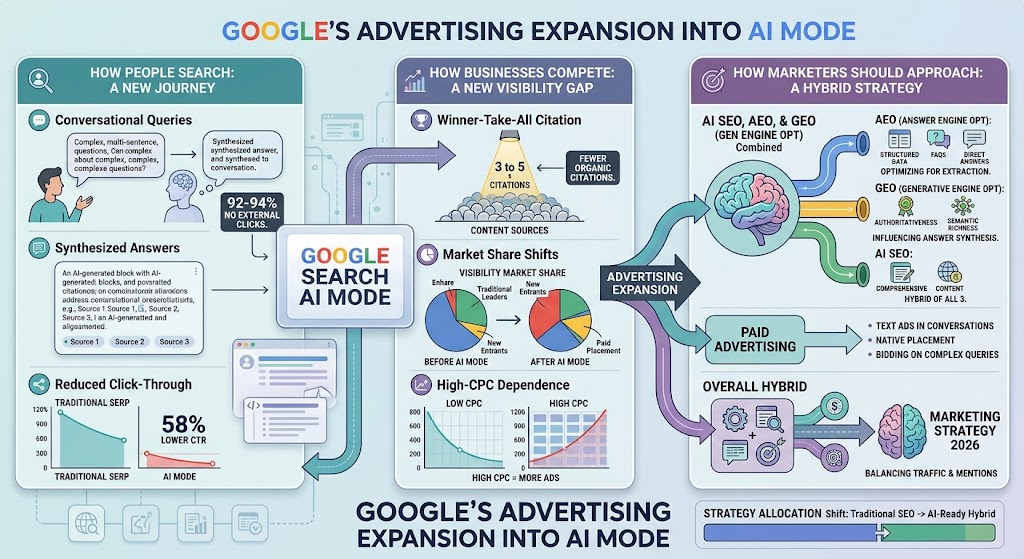
Google’s AI Mode Ads expansion is changing how people search, how businesses compete for visibility and how digital marketers should approach SEO, AEO, GEO and paid advertising.

Table of Contents
Suggested URL slug:
Focus keyword:
Secondary keywords:
Meta description:
Introduction: Search is changing, and digital marketing must change with it
For years, digital marketing has been built around a relatively familiar customer journey.
A person searches for a product or service on Google, reviews the available websites, compares different providers and eventually clicks through to make a purchase or submit an enquiry.
Businesses compete for visibility through search engine optimisation (SEO), paid search advertising, content marketing and social media.
However, artificial intelligence is changing this journey.
Instead of entering a short keyword such as “best accounting software”, users can now ask detailed questions:
- Which accounting software is suitable for a small business with five employees?
- What are the advantages of cloud-based accounting?
- Which platform offers affordable inventory management?
- Can you compare three options based on price, features and customer support?
AI-powered search experiences can interpret these longer questions, provide contextual responses and help users explore additional questions without following the traditional sequence of search results.
Google’s AI Mode is part of this transformation.
On 28 October 2026, Google announced that advertisements in AI Mode were expanding to ten additional markets, including Pakistan, India, Malaysia, Australia, Canada and Singapore.
The announcement represents an important development for businesses advertising through Google.
It also raises a larger question:
If search is becoming conversational and AI-driven, will traditional SEO and PPC strategies remain effective?
The answer is that they will need to evolve.
1. What is Google AI Mode Ads?
Google AI Mode is an AI-powered search experience designed to help users explore complex questions through conversational interactions.
Unlike conventional search, where users typically enter a query and receive a list of links, AI Mode can generate a synthesised response and allow users to ask follow-up questions.
For example, someone looking for a digital marketing agency might begin with:
“How do I generate more international clients for my consultancy business?”
They could then ask:
- Which digital channels should I prioritise?
- How much should I spend on advertising?
- What should my website include?
- How can I measure lead quality?
AI Mode is designed to support this kind of multi-step information discovery.
This creates a different environment for marketers because customers may interact with several pieces of information before clicking through to a website.
2. Google expands AI Mode advertising to Pakistan
On 28 October 2026, Google announced the expansion of ads in AI Mode to ten additional markets.
These included:
- Australia.
- Canada.
- India.
- Kenya.
- Malaysia.
- New Zealand.
- Nigeria.
- Pakistan.
- The Philippines.
- Singapore.
Google explained that AI Mode searches are, on average, three times longer than traditional searches.
This suggests that users are increasingly expressing their needs in more detailed, conversational language.
Google also reported that, in its testing, click-through rates for sponsored and organic product-listing items within AI Mode were similar.
These are Google’s own reported observations, not independent evidence that every advertiser or industry will achieve comparable results.
Google says advertisements will be clearly identified as sponsored content.
The company is also expanding experimentation with advertising in follow-up queries, initially through its US multiturn advertising experience.
For Pakistani businesses, the expansion is particularly relevant because it creates another environment in which eligible Google Ads campaigns may reach customers.
However, availability of a new advertising placement does not guarantee better conversions or lower acquisition costs.
Advertisers will need to monitor actual performance.
3. How is AI changing traditional search behaviour?
The biggest change is the transition from keyword-based discovery towards intent-based discovery.
Consider the following comparison.
| Traditional search | Conversational AI search |
|---|---|
| Best digital marketing agency | Which agency can help my small business attract international customers on a limited budget? |
| SEO services Lahore | How can I improve my website’s visibility in Google and AI-generated search results? |
| Business consultant Pakistan | What should I look for when hiring a business consultant to improve operations and marketing? |
| Best online course | Which online marketing course offers practical skills and recognised certification? |
The second column reflects more detailed user intent.
This has important consequences for keyword research, content planning and advertising.
Businesses should not abandon conventional keyword optimisation. Instead, they should understand the questions, problems and commercial objectives behind those keywords.
4. Is traditional SEO becoming less important?
No. SEO remains important, but the environment in which search visibility is earned is evolving.
Search engines and AI-powered experiences need information that can be discovered, understood, evaluated and retrieved.
Websites that provide useful, accurate, well-organised information can strengthen their opportunities to appear in relevant search experiences.
Businesses should focus on the following areas.
A. Search intent
Content should address what people actually want to know.
A page targeting “business strategy consultant” should explain the services offered, the problems addressed, the process followed and the outcomes clients can reasonably expect.
Businesses should build meaningful coverage of the subjects in which they have genuine expertise.
For example, a consultancy specialising in SME development could publish connected articles about:
- Business planning.
- Operational efficiency.
- Marketing strategy.
- Financial management.
- HR policies.
- Digital transformation.
- Business risk management.
This creates a coherent body of useful information.
C. Structured and accessible content
Use clear headings, descriptive page titles, concise explanations, useful tables and properly organised internal links.
Structured information helps users navigate content and supports search-engine understanding.
D. First-hand experience and credibility
Generic content is increasingly easy to reproduce.
Businesses should differentiate themselves through original research, professional experience, practical examples, expert commentary and transparent sourcing.
E. Technical SEO
A website still needs to be crawlable, indexable, mobile-friendly and technically sound.
AI visibility does not compensate for broken URLs, incorrect redirects, poor page performance or inaccessible content.
5. AEO and GEO: What do businesses need to understand?
Two terms increasingly appear in digital marketing discussions.
Answer Engine Optimisation (AEO) focuses on making content useful and understandable for systems that provide direct answers to user questions.
Generative Engine Optimisation (GEO) focuses on improving the likelihood that relevant content will be discovered, retrieved or cited in generative AI experiences.
These approaches complement SEO rather than replace it.
Practical comparison
| Discipline | Primary objective |
|---|---|
| SEO | Improve visibility in conventional search results |
| AEO | Make content useful for direct answers |
| GEO | Improve discoverability in generative AI experiences |
| PPC | Generate paid visibility and traffic |
| CRO | Improve the proportion of visitors who convert |
A strong digital marketing strategy should connect all five.
However, businesses should avoid purchasing services based on promises of guaranteed AI citations or guaranteed placement in AI-generated answers. No agency can legitimately guarantee those outcomes.
6. What happens to Google Ads and PPC?
The expansion of advertising into AI Mode creates new opportunities, but it also raises important measurement questions.
Traditional paid search often relies on a relatively direct relationship between:
- Search query.
- Keyword targeting.
- Advertisement.
- Landing page.
- Conversion.
Conversational search may introduce more complex customer journeys.
A user could explore several related questions before clicking an advertisement.
This may create new opportunities for advertisers to reach people with more clearly expressed needs.
However, it also makes it important to assess whether advertising expenditure is generating meaningful business results.
What advertisers should monitor
- Impressions and click-through rates.
- Cost per click.
- Conversion rates.
- Cost per qualified lead.
- Customer acquisition cost.
- Return on advertising spend.
- Lead quality and sales outcomes.
- Performance by campaign and landing page.
A high click-through rate is not automatically a sign of business success.
An advertisement that attracts many visitors but generates few qualified leads may be less valuable than a smaller campaign with stronger conversion performance.
7. What should Pakistani SMEs do now?
The arrival of AI Mode advertising in Pakistan makes this an appropriate time for businesses to review their digital marketing strategies.
Step 1: Audit your website
Check:
- Whether important pages are indexed.
- Whether your service descriptions are accurate.
- Whether contact information is easy to find.
- Whether pages work properly on mobile.
- Whether your website loads efficiently.
- Whether internal links are working.
- Whether your sitemap and robots.txt are correctly configured.
Step 2: Build question-led content
Create articles that answer genuine customer questions.
For example, a digital marketing consultancy could publish:
- How much does digital marketing cost in Pakistan?
- Is SEO better than Google Ads for small businesses?
- How can Pakistani businesses attract international clients?
- What is the difference between SEO, AEO and GEO?
- How do you calculate the return on digital advertising?
Answers should be direct, informative and supported by evidence.
Step 3: Improve conversion-focused landing pages
Every important service page should explain:
- The customer’s problem.
- The service being offered.
- The approach and process.
- Relevant experience or evidence.
- Expected deliverables.
- A clear next step.
Step 4: Review your Google Ads campaigns
Do not assume that you need to create an entirely new campaign simply because advertising is appearing in AI Mode.
Review Google’s current eligibility and campaign guidance.
Check your search terms, negative keywords, landing pages, conversion tracking and budget allocation.
Step 5: Measure business outcomes
Connect website analytics with actual business enquiries and sales.
For service businesses, a qualified lead is usually more valuable than an unqualified website visit.
8. The new opportunity for digital marketing agencies
AI-powered search creates opportunities for agencies to provide more strategic services.
Instead of offering only keyword optimisation or social media posting, agencies can help businesses improve their overall digital discoverability and conversion systems.
Potential service areas include:
AI-search readiness assessments: Review website structure, content quality, technical SEO and answer-focused content.
SEO and content strategy: Develop topic clusters, useful articles, internal linking and conversion-focused service pages.
Google Ads management: Build and optimise paid campaigns around customer intent and measurable outcomes.
Conversion optimisation: Improve landing pages, enquiry forms and customer journeys.
Digital analytics: Connect organic traffic, paid advertising, lead quality and commercial results.
Digital reputation management: Strengthen the accuracy and consistency of business information across online platforms.
These services can be particularly valuable to Pakistani SMEs seeking international customers.
9. What should digital marketers stop doing?
The evolution of search also exposes several outdated practices.
Businesses and agencies should reconsider:
- Publishing large volumes of repetitive, low-value AI-generated articles.
- Targeting keywords without understanding search intent.
- Measuring success only through impressions and website visits.
- Creating pages that contain generic claims without evidence.
- Buying backlinks from irrelevant or low-quality websites.
- Making unsupported promises about AI rankings.
- Running advertisements without reliable conversion tracking.
- Treating social media followers as equivalent to paying customers.
The objective should be to build genuine visibility, trust and commercial performance.
10. What might digital marketing look like over the next two years?
The following are plausible developments, not guaranteed outcomes.
More conversational customer journeys
People may increasingly use AI-powered interfaces to research, compare and evaluate products and services.
Greater competition for trusted visibility
Businesses will need credible information, strong brands and useful original content to differentiate themselves.
More complex paid advertising environments
Advertisers may have to evaluate performance across traditional search results, AI-powered experiences and other discovery channels.
Greater importance of first-party data
Businesses should build permission-based customer databases, email lists and direct customer relationships rather than relying exclusively on third-party platforms.
Integration of marketing and business analytics
Marketing performance will increasingly need to be measured through qualified enquiries, revenue and customer lifetime value.
Conclusion: The future of digital marketing is not the end of SEO—it is the evolution of discoverability
Google’s expansion of AI Mode advertising into Pakistan is an important development for the country’s digital marketing industry.
It introduces new opportunities for advertisers while accelerating changes in how people discover information, compare services and make purchasing decisions.
However, businesses should not interpret AI-powered search as a reason to abandon established marketing principles.
Relevant content, technical website quality, credible expertise, clear positioning, effective advertising and measurable conversions remain fundamental.
The difference is that businesses must now consider how their information performs across a wider range of discovery experiences.
The next generation of successful digital marketing strategies will combine SEO, AEO, GEO, PPC, conversion optimisation and strong customer relationships.
For Pakistani SMEs, the opportunity is significant.
Those that build credible digital assets, understand customer intent and measure commercial outcomes can compete more effectively in both local and international markets.
The future of digital marketing is not simply about being found. It is about being understood, trusted and chosen.
Frequently asked questions
1. What is Google AI Mode advertising?
It is Google’s advertising experience within AI-powered search, allowing sponsored content to appear in relevant AI Mode experiences.
2. Is Google AI Mode advertising available in Pakistan?
Google announced the expansion of AI Mode advertising to Pakistan on 28 October 2026.
3. Will AI Mode replace traditional SEO?
No. Conventional SEO remains important for discoverability. However, businesses should also develop content that supports conversational search and AI-generated answers.
4. What is the difference between SEO, AEO and GEO?
SEO focuses on search visibility, AEO on providing useful direct answers and GEO on discoverability within generative AI experiences.
5. Should Pakistani businesses change their Google Ads campaigns?
They should review campaign eligibility, targeting, landing pages, conversion tracking and performance. They should not assume that a completely new campaign is required.
6. How can a small business prepare for AI-powered search?
Start with an accurate, technically sound website, useful question-led content, clear service pages, credible business information and reliable conversion tracking.
References and further reading
- Google – Ads in AI Mode Expand to New Markets, 28 October 2026
- Google Search Central – SEO Starter Guide
- Google Search Central – Creating Helpful, Reliable, People-First Content
- Google Ads – Help Centre
- Google Analytics
- Google Search Console
DMMS Digital Marketing & Business Consulting
Is your business visible where your customers are searching?
DMMS helps businesses develop SEO, AI-search readiness, digital marketing and conversion strategies that connect online visibility with measurable business growth.
For a website and digital marketing assessment:
Website: https://dmms.pk
WhatsApp: +92 323 8886780
DMMS – Multiple Management Solutions | Digital Visibility. Strategic Growth. Measurable Results.


Share your views on it