

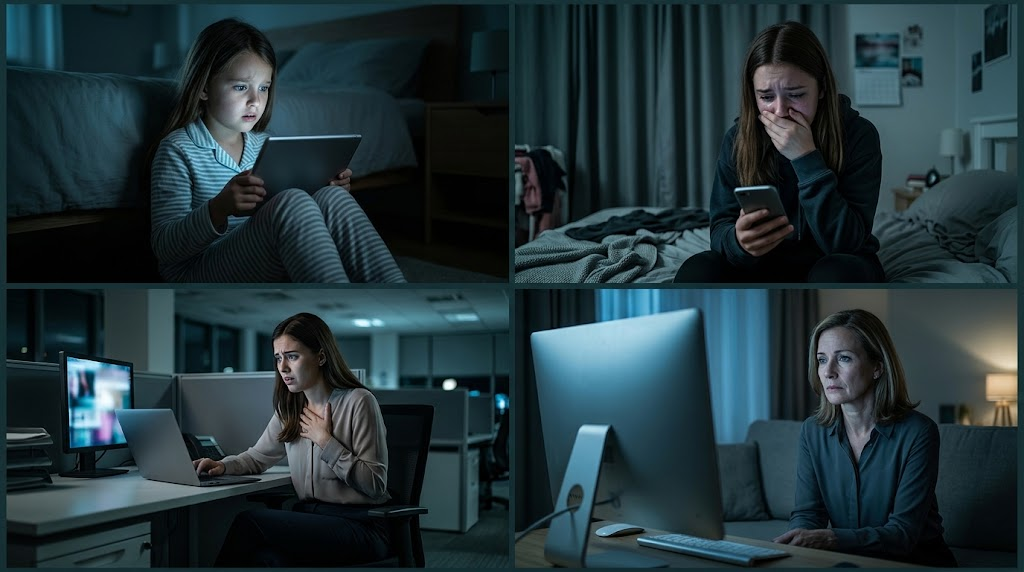

When a photograph can be turned into a weapon, digital safety becomes personal safety.
Imagine waking up one morning and discovering that a photograph of you has been manipulated by AI.

Perhaps your face has been placed onto somebody else’s body.
Perhaps a fake video has been created.
Perhaps someone is threatening to publish an intimate image—or a completely fabricated one.
Perhaps your daughter, sister, wife, colleague or friend has become the target.
And perhaps the first thing you hear is:
“Why did she have that picture?”
That question is part of the problem.
The better question is:
“Who created or shared this without her consent—and what can we do to protect her?”
AI has made image manipulation dramatically easier. At the same time, governments, regulators, technology companies and civil-society organisations around the world are beginning to recognise that online abuse is not simply a matter of “being careful on the internet.”
It can affect a person’s privacy, dignity, reputation, education, employment, relationships, mental wellbeing and physical safety.
And this is not only a problem somewhere else.
It is happening in Pakistan too.
The issue in one sentence
Non-consensual intimate images (NCII), AI-generated sexual deepfakes, cyberstalking, blackmail, impersonation and coordinated harassment are increasingly becoming part of the wider technology-facilitated violence experienced by women and girls around the world—including in Pakistan.
The response therefore cannot be:
“Women should simply stay offline.”
The response must be:
Protect people. Hold abusers accountable. Improve technology. Strengthen reporting systems. Educate families. And build communities where survivors are believed rather than blamed.
1. This is a global problem—not a problem belonging to one country
Technology-facilitated violence against women and girls is increasingly recognised internationally as a serious safety and human-rights issue.
The United Nations reports that misinformation and defamation are among the most prevalent forms of online violence against women, while deepfake technology has created a particularly serious new dimension of image-based abuse. UN sources also report that women are disproportionately targeted by non-consensual sexual deepfakes.
A 2025 global partnership statement on non-consensual intimate images describes NCII as including not only the sharing of private sexual images without consent, but also threats to share them and AI-generated or manipulated synthetic images such as deepfakes. The statement emphasises that the harm crosses borders and requires stronger legal, technological and victim-support responses.
This matters because the internet does not respect national borders.
A fake image can be:
Created in one country → uploaded from another → shared through a global platform → downloaded by people in several countries → copied into private groups → and resurfaced months or years later.
That makes digital abuse fundamentally different from many traditional forms of harassment.
2. AI has changed the scale of the problem
Before generative AI became widely accessible, manipulating a photograph usually required specialised software and some degree of technical skill.
Today, increasingly sophisticated AI tools can make realistic-looking images and videos much more accessible.
The result is a dangerous shift:
From:
“Can someone technically create this?”
To:
“How quickly can someone create and distribute it?”
That distinction matters.
A woman does not have to have taken an intimate photograph.
She does not have to have consented to the image.
She does not even have to have met the person creating it.
A publicly available photograph can potentially become raw material for manipulation.
This is why AI deepfake abuse must not automatically be treated as a victim’s failure to protect her privacy.
3. What exactly is NCII?
NCII = Non-Consensual Intimate Image Abuse.
It generally refers to intimate or sexually explicit images or videos being shared, created, manipulated, or threatened to be shared without the person’s consent.
This can include:
- privately taken intimate images shared without permission
- threats to publish intimate images
- sexually explicit deepfakes
- manipulated photographs
- AI-generated sexual imagery depicting a real person
- images obtained through hacking or deception
- impersonation connected to sexual exploitation
- blackmail or sextortion involving intimate material
It is important to understand one principle:
Consent to take a photograph is not consented to distribute it.
And:
A person’s public photograph is not consented to sexually manipulate it.
4. The global regulatory direction is changing
One of the clearest examples comes from the United Kingdom.
Ofcom—the UK’s communications regulator—has been developing stronger online-safety measures addressing harms that disproportionately affect women and girls.
Its current work covers issues including:
- image-based sexual abuse
- misogynistic abuse and sexual violence
- stalking and coercive control
- pile-ons and coordinated harassment
Ofcom’s September 2026 Call for Evidence is specifically seeking evidence about women’s and girls’ experiences of these harms and how online services are responding. The consultation closes at 5pm on 4 November 2026, with a report planned for Q2 2027.
But there is an important date distinction.
4 November 2026 is NOT the hash-matching deadline.
Ofcom’s strengthened measures concerning NCII and hash matching came into force on 30 September 2026.
Ofcom is now running an enforcement programme examining whether relevant services are complying with their duties.
Certain platforms are expected to use hash matching—or demonstrate equally effective alternatives—to detect and reduce the spread of illegal intimate images, including explicit AI-generated deepfakes. Ofcom says firms failing to meet their legal duties can face significant penalties, potentially including fines of up to 10% of global annual revenue.
This represents an important philosophical shift:
Old approach:
“The victim should report it after it happens.”
Emerging approach:
“Platforms should build systems that help prevent known harmful material from spreading in the first place.”
That is the idea of safety by design.
5. What is hash matching—and why should ordinary people care?
Hash matching sounds technical.
The basic idea is actually quite simple.
Think of a digital fingerprint for an image.
A system converts an image into a mathematical identifier called a hash.
If the same image—or a version detectable by the relevant system—is uploaded again, the platform can compare its hash against known harmful material.
This can help platforms identify and prevent repeated sharing.
Ofcom has recommended hash-matching measures for certain services, while StopNCII provides a practical example of how image hashing can work for people experiencing NCII abuse. StopNCII says the hash is generated on the user’s device and the original image itself is not uploaded to its system. Participating platforms can then use the hash to detect matching material under their policies.
Important: StopNCII does not remove content from the entire internet. It works with participating platforms.
So technology is part of the solution—but it is not the entire solution.

We still need:
people + platforms + law + education + support + community.
6. Now bring this conversation home: Pakistan
This is where the discussion becomes particularly important for Pakistani readers.
Pakistan is not simply watching this global problem from the sidelines.
In March 2026, the Ministry of Human Rights, together with UNDP, launched Pakistan’s first National Strategy to Counter Technology-Facilitated Gender-Based Violence (TFGBV).
The strategy recognises online harms including:
- harassment
- cyberstalking
- image-based abuse
- impersonation
- coordinated online intimidation
It also frames digital safety as a matter of participation, rights, protection and institutional responsibility.
That is an important development.
Because Pakistan’s digital population is changing rapidly.
According to the strategy’s published figures, 8 million new female users came online in Pakistan in 2024.
More women and girls are entering:
- education
- e-commerce
- freelancing
- remote employment
- entrepreneurship
- social media
- content creation
- digital communities
- online banking
- professional networking
That is good news.
But digital inclusion without digital safety creates a dangerous imbalance.
7. Pakistan’s digital-access story has another side
The same national strategy reports that in 2024 Pakistan received 135,000 cybercrime complaints, while only 826 cases proceeded to prosecution—approximately 0.6% of the reported complaints.
These figures need to be interpreted carefully: a complaint is not necessarily a proven crime, and prosecution numbers do not tell us everything about investigations, withdrawals, settlements or other outcomes.
But the figures still illustrate a serious institutional challenge:
Access to technology is expanding faster than many people’s confidence in the systems designed to protect them.
That is why awareness matters.
Knowing what to do before a crisis happens can make an enormous difference.
8. Pakistani women are already experiencing these harms
Digital Rights Foundation’s 2026 research documented 5,041 new cases handled by its Digital Security Helpline between May 2024 and December 2025.
Its report identifies hacking, image-based abuse—including AI-generated deepfakes—blackmail, sextortion and coordinated online harassment among significant threats.
It also reports that women and trans women faced high rates of hacking, image-based abuse, blackmail and sextortion in the cases handled by the helpline.
This gives the discussion a very important local dimension.
We are not talking about some distant technological possibility.
We are talking about people in Pakistan who may already be experiencing:
“Someone has my picture.”
“Someone is threatening me.”
“Someone has created a fake account in my name.”
“Someone has made an AI image of me.”
“Someone is blackmailing me.”
“Someone is sending this to people I know.”
And sometimes:
“I don’t know who I can tell.”
9. And this is where culture matters
Technology may be global.
Human reactions are not.
In Pakistan and many other societies, a woman facing intimate-image abuse may fear more than the perpetrator.
She may fear:
- her parents finding out
- her husband finding out
- her in-laws
- her school or university
- her employer
- her community
- gossip
- social isolation
- being labelled
- being blamed
- losing a marriage
- losing a job
- damaging her family’s reputation
A teenager may fear her parents.
A married woman may fear her family.
A professional may fear losing credibility.
A mother may fear what her children will think.
A young girl may simply feel that her entire life is over.
That is why the first response matters.
If someone comes to you and says:
“Someone is threatening me with my pictures.”
Do not begin with:
“Why did you send them?”
Start with:
“Are you safe?”
Then:
“I believe you.”
Then:
“Let’s deal with this together.”
That simple change can prevent a crisis from becoming a catastrophe.
10. What families in Pakistan need to teach their daughters—and sons
Digital safety education should not be a lecture delivered only to girls.
Boys need this education too.
Children and teenagers need to understand:
Never:
- forward intimate material
- save or circulate abusive content for entertainment
- threaten someone with their photographs
- pressure someone for private images
- create sexualised AI images of real people
- participate in harassment groups
- assume disappearing messages are permanently gone
- share someone’s private information as revenge
And equally important:
Teach children that asking for help is not an admission of guilt.
A child who is being blackmailed may already feel trapped.
If the family response is:
“How could you do this?”
the child may disappear deeper into the problem.
If the response is:
“You are not alone. We will handle this together.”
you create a path toward safety.
11. What should YOU do if this happens to you?
If you—or someone you know—is targeted, remember this sequence:
1. DON’T PANIC
Do not immediately negotiate.
Do not promise money.
Do not send additional photographs.
Do not meet the person.
Do not threaten them back.
And do not let shame make you disappear.
2. PRESERVE EVIDENCE
Before blocking or deleting anything, where it is safe and practical to do so, preserve relevant evidence.
Record:
- usernames
- profile URLs
- messages
- dates and times
- threats
- payment demands
- relevant screenshots
- links
- email addresses
- phone numbers
- platform names
Keep evidence somewhere secure.
If the material involves a child, do not unnecessarily download, forward or circulate sexual imagery involving the child. Seek appropriate professional and law-enforcement assistance.
3. SECURE YOUR ACCOUNTS
Immediately review:
- passwords
- two-factor authentication
- active sessions
- recovery email
- recovery phone
- connected devices
- privacy settings
- cloud-photo access
- shared albums
- unfamiliar applications
Remove unknown devices and sessions.
Change reused passwords.
12. Report the abuse—but know where to go
For Pakistani users, the National Cyber Crime Investigation Agency (NCCIA) is now the relevant national law-enforcement agency for cybercrime investigations and prosecutions under the current framework.
NCCIA says victims can submit complaints through its online complaint system, Pakistan Citizen Portal, email, or by visiting a Cybercrime Reporting Centre. It also lists 1799 as its helpline.
NCCIA official complaint portal
NCCIA official website and reporting information
For additional survivor-centered digital-security support in Pakistan, Digital Rights Foundation operates a confidential Digital Security Helpline.
Helpline: 0800-39393
Email: helpdesk@digitalrightsfoundation.pk
DRF states that the helpline provides support concerning online harassment and digital-security threats and is available seven days a week during its published operating hours.
Digital Rights Foundation — Digital Security Helpline
You do not have to choose between legal action and emotional support.
In many situations, you may need both.
13. What about StopNCII?
If you are an adult dealing with non-consensual intimate images, StopNCII.org may provide another layer of protection on participating platforms.
It generates a digital fingerprint/hash from the selected image or video on your device rather than sending the original image to StopNCII, and participating platforms can use the hash to identify matching content under their policies.
StopNCII — create a case or learn how it works
StopNCII also offers information in Urdu, which can make the service easier to understand for Pakistani users.
However, remember:
No single tool can protect the entire internet.
Use a combination of:
platform reporting + evidence preservation + account security + trusted support + appropriate legal reporting.

14. A Pakistani family’s Digital Safety Agreement
Instead of waiting for something terrible to happen, families can agree on five rules.
Rule 1 — We don’t shame someone for being targeted.
Rule 2 — We don’t forward abusive material.
Rule 3 — We preserve evidence before deleting relevant information.
Rule 4 — We seek help early.
Rule 5 — We protect one another’s digital dignity.
Put this somewhere children can remember it.
Because the most valuable digital-safety tool in a home is not an app.
It is a family that knows how to respond.
15. Women should not have to become invisible to become safe
There is a dangerous conclusion that sometimes emerges from conversations about online abuse:
“Women should stop posting photographs.”
“Women should not have public profiles.”
“Women should not participate in social media.”
“Women should not build personal brands.”
“Women should simply stay offline.”
That may sound protective.
But it can create another form of harm.
Today, women use digital spaces for:
- education
- employment
- freelancing
- entrepreneurship
- professional networking
- activism
- community building
- Islamic education
- parenting communities
- e-commerce
- financial independence
- creative work
For many women, going offline is not a realistic solution.
The goal should therefore be:
Not invisible women. Safer women.
16. What Pakistani businesses, schools and universities should do
Digital safety should not be left entirely to individuals.
Organisations need policies.
A school should know what happens when a student’s image is abused online.
A university should have a clear reporting mechanism.
An employer should know how to respond when an employee is targeted.
A women’s community should know where to refer a survivor.
A digital platform should have:
- clear reporting mechanisms
- escalation routes
- trained moderators
- rapid response procedures
- privacy protections
- impersonation reporting
- NCII response procedures
- account-security support
- documented incident-response policies
And leadership should understand one thing:
Digital abuse can become a real-world safeguarding issue.
17. Why this matters globally—and why Pakistan matters in this conversation
Pakistan’s National TFGBV Strategy is significant because it places technology-facilitated gender-based violence within a national policy framework rather than treating individual online abuse as isolated incidents.
At the same time, the global direction is moving toward stronger platform responsibility.
The UK is strengthening platform expectations around NCII and hash matching.
International organisations are calling for survivor-centred responses.
Civil-society organisations are documenting the impact.
Technology companies are being pushed toward safety-by-design approaches.
And countries are beginning to recognise that:
Digital rights are human rights.
The Pakistani conversation needs to be part of this global conversation.
Not as a passive recipient of international policy.
But as a country developing its own approaches to a rapidly changing digital environment.
18. There is also a Muslim-community dimension
For Muslim families and communities, this conversation has an additional layer.
We often speak about:
haya, dignity, honour, privacy, amanah and protecting one another.
Those values should not become tools for blaming a survivor.
They should become reasons for protecting her.
If someone’s private image is stolen, manipulated or weaponised, the moral failure belongs with the person committing the abuse—not automatically with the person being targeted.
Our communities should become places where a woman can say:
“Something has happened to me online.”
and hear:
“We are with you. Let’s protect you.”
rather than:
“What did you do to cause this?”
That is what genuine community protection looks like.
19. Project Tahaffuz: protection must include the digital world
Physical safety and digital safety can no longer be treated as two completely separate subjects.
A woman can be physically safe inside her home and still be:
- stalked online
- impersonated
- blackmailed
- digitally monitored
- sexually harassed
- targeted by coordinated abuse
- threatened with intimate images
A child can be physically safe at school and still be exposed to:
- cyberbullying
- grooming
- manipulation
- sextortion
- harmful communities
- AI-generated abuse
This is why the idea behind Project Tahaffuz is so relevant to the modern Muslim family:
Protection should cover both worlds.

Physical safety + digital safety + awareness + community support.
Because today’s home has another door.
It is called the internet.
20. Your 10-minute digital safety check
You do not need to become a cybersecurity expert today.
Take ten minutes.
Is two-factor authentication enabled on your email?
Review active sessions on your Google, Apple, Facebook, Instagram and other important accounts.
Remove devices you no longer recognize.
Check who can see your social-media posts.
Review old public photographs.
Check whether your children’s school, home, routine or location is unnecessarily visible online.
Review apps with access to your photos, camera, microphone and location.
Talk to your children about online blackmail.
Tell one person:
Save your country’s cybercrime reporting information somewhere accessible.


“If something ever happens to me online, I can come to you without being judged.”
That may be the most important security measure on this list.
21. If you are reading this because it has already happened to you
Please pause here.
Take a breath.
You are not the image.
You are not the video.
You are not the rumour.
You are not the account someone created in your name.
You are not the shame someone is trying to put on you.
And you do not have to solve the entire problem tonight.
Start with one safe person.
Then preserve evidence.
Secure your accounts.
Report the abuse.
Seek appropriate professional or legal support.
And remember:
Asking for help is a safety action—not a weakness.
22. If you are a parent, don’t wait until your child is in crisis
Have this conversation before something happens.
Ask:
“If someone online ever threatens you, would you feel comfortable telling me?”
Then say:
“Even if you think you made a mistake, come to me first. We will solve the safety problem first. We can discuss everything else later.”
That sentence could determine whether a child asks for help—or suffers alone.
23. If you are a friend, sister, colleague or community leader
You may be the person someone approaches first.
Your response can either open the door to safety or close it.
Instead of:
“Why did you trust him?”
Try:
“I’m sorry this happened. Let’s work out what to do next.”
Instead of:
“Don’t tell anyone.”
Try:
“Let’s identify one or two trusted people who can support you safely.”
Instead of:
“Delete everything.”
Try:
“Let’s preserve the evidence we may need before removing anything.”
Instead of:
“Just ignore it.”
Try:
“Let’s assess the risk and decide the safest reporting route.”
24. The bigger lesson: safety cannot be outsourced entirely to women
Women should absolutely learn digital-security skills.
Children should learn them.
Parents should learn them.
Teachers should learn them.
Employers should learn them.
Community organisations should learn them.
But platforms and institutions also have responsibilities.
The future of online safety cannot be:
“Everyone should be more careful.”
It has to become:
“Everyone who has power to prevent harm should use that power responsibly.”
That includes:
technology companies.
governments.
law-enforcement agencies.
schools.
employers.
parents.
communities.
and each one of us.
25. What can YOU do today?
Choose just one action.
If you’re a woman:
Secure your most important account with 2FA.
If you’re a parent:
Have a 10-minute digital-safety conversation with your child.
If you’re a teacher:
Add digital-abuse reporting to your safeguarding plan.
If you’re an employer:
Create a confidential process for reporting online harassment.
If you’re a community leader:
Learn where survivors can obtain support.
If you’re a friend:
Become the person who listens without blaming.
If you’re a social-media user:
Never forward someone’s intimate or humiliating material—even if it is already circulating.
If you’re building a digital platform:
Ask whether safety is built into the product before harm occurs.
26. And please don’t keep this information to yourself
There is a strange contradiction in online safety.
We often say:
“I wish someone had told me earlier.”
Then we find useful information—and keep scrolling.
Don’t.
If this article helped you understand even one thing you did not know before, share it with someone you care about.
Send it to:
- your sister
- your daughter
- your son
- your husband
- your wife
- your friend
- your university group
- your workplace
- your parents
- your community
You do not need to wait for someone to become a victim before giving them safety information.
Awareness is prevention.
27. Become part of the conversation
If you believe digital safety should be treated as part of everyday family and community safety, join our newsletter.
We will continue exploring:
AI & digital safety
women and children’s protection
online rights
family safety
cybersecurity
digital parenting
Islamic perspectives on dignity and responsibility
practical tools you can actually use
and major developments that affect ordinary people—not just technology experts.
You don’t need to be a cybersecurity professional.
You just need to care about protecting yourself and the people around you.
Subscribe. Learn. Share. Protect.
Because safer digital communities are built by people who look out for one another.
A final message to every reader
The internet is now part of our homes.
Our children study there.
Our businesses operate there.
Our careers grow there.
Our communities gather there.
Our families communicate there.
Our identities increasingly exist there.
So protecting people online is not about being afraid of technology.
It is about learning to use technology without surrendering our dignity, rights or safety.
The global conversation is changing.
Pakistan’s conversation is changing.
Technology is changing.
Now our communities must change too.
Not by teaching women to disappear.
Not by teaching victims to remain silent.
Not by normalising harassment.
But by building a culture in which:
privacy is respected,
consent matters,
children know where to turn,
women can participate confidently,
survivors are not blamed,
abusers are challenged,
platforms are held accountable,
and communities protect their own.
Tahaffuz begins with awareness.
And awareness becomes powerful when we share it.
Frequently Asked Questions
What is an AI deepfake?
An AI deepfake is synthetic or manipulated media created or altered using artificial-intelligence techniques so that a person may appear to say, do or participate in something that did not actually happen.
When such technology is used to create sexualised or intimate material depicting someone without their consent, it can become a form of image-based abuse.
What is NCII?
NCII stands for Non-Consensual Intimate Image Abuse. It generally involves intimate or sexually explicit material being created, shared, distributed or threatened without the person’s consent. AI-generated or manipulated intimate imagery can also fall within this broader category.
Are deepfakes only a problem in Western countries?
No.
AI-generated abuse is a global issue. Pakistan’s own national TFGBV strategy recognises image-based abuse, impersonation, cyberstalking and other technology-facilitated harms affecting women and girls.
What should I do if someone threatens me with an intimate image in Pakistan?
Do not negotiate or send additional material.
Preserve relevant evidence, secure your accounts, report the content to the platform, and consider reporting the matter to NCCIA.
You can also seek confidential digital-security support through Digital Rights Foundation’s helpline.
Digital Rights Foundation Digital Security Helpline
Can StopNCII remove an image from the entire internet?
No.
StopNCII works with participating platforms. It creates a hash/digital fingerprint that participating companies can use to detect matching material under their systems and policies.
Does having a public social-media profile mean someone can legally use my photograph sexually?
A photograph being publicly visible does not automatically mean someone has consent to sexually manipulate or abuse the person depicted. The legal position depends on the conduct, jurisdiction and circumstances. If you are affected, obtain appropriate legal advice rather than assuming that being publicly visible means you have no rights.
Should women stop posting photographs online?
No single rule can eliminate digital risk, and choosing more restrictive privacy settings can be sensible for some people.
But telling women collectively to disappear from digital spaces is not an adequate solution.
Women increasingly depend on digital platforms for education, employment, business, professional networking and community participation.
The goal should be safer participation, not forced invisibility.
What should parents teach children about deepfakes?
Teach children that:
- Not everything online is real.
- Their images can be manipulated.
- They should never create or share sexualised images of another person.
- They should never forward abusive content.
- They should not negotiate with online blackmailers alone.
- They can tell a trusted adult—even if they think they made a mistake.
Sources & Further Reading
Global perspective
United Nations — Online violence against women resources
Global Partnership statement on NCII abuse
UN Women — Online violence in the AI age
United Kingdom / Ofcom
Ofcom — A Safer Life Online for Women and Girls: Call for Evidence
Ofcom — Creating a safer life online for women and girls
Ofcom — Illegal intimate images and deepfakes
Ofcom — NCII enforcement programme
Pakistan
UNDP Pakistan — National Strategy to Counter Technology-Facilitated Gender-Based Violence
UNDP Pakistan — Launch of the National TFGBV Strategy
Digital Rights Foundation — 2026 report on digital threats in Pakistan
NCCIA — Cybercrime reporting and FAQs
NCCIA — Cyber harassment guidance
Digital Rights Foundation — Digital Security Helpline
Practical protection
StopNCII — How hash matching works
- AI Deepfakes, Intimate Image Abuse & Women’s Digital Safety: What Every Woman, Parent and Community Needs to Know in 2026
- How Specialization + Proof of Work Help You Earn Online in Pakistan’s Growing Digital Economy
- How Do I Create an Email That Converts Like Magic
- The Working Group No. 6
- When the Curtain Falls: Understanding the Grand Design Behind World Events


Share your views on it